

You finally pulled the trigger on a curved sofa. It’s sitting in the middle of your living room and something feels… off.
Don’t panic. That’s almost always a layout problem, not a sofa problem.
Curved sofas are the biggest furniture trend of 2026 – and for good reason. Their soft, organic silhouettes break up boxy rooms, create natural conversation flow, and make a space feel designed rather than just furnished. But they don’t follow the same rules as a standard three-seater. Push a curved sofa against a wall and it looks wrong immediately. Leave too little clearance and the whole room feels blocked.
This guide covers exactly how to style a curved sofa with 7 living room layouts that actually work – from open-plan apartments to small square rooms – so your sofa looks the way it did in the showroom.
Table of Contents
- Why Curved Sofas Need Different Layout Rules
- Layout 1: The Classic Float
- Layout 2: The Conversation Circle
- Layout 3: Open-Plan Zone Divider
- Layout 4: The Corner Crescent
- Layout 5: Small Room Focal Point
- Layout 6: The Symmetrical Pair
- Layout 7: The Art Deco Statement
- What to Pair With a Curved Sofa
- Common Mistakes to Avoid
- Final Thoughts
Why Curved Sofas Need Different Layout Rules
A straight sofa has one job: line people up along a wall and face them toward a TV or fireplace. A curved sofa has a completely different function. Its arc naturally angles everyone toward each other, which means it works best when it’s treated like the room’s focal point – not just one piece of furniture among many.
Curved sofas solve three problems that rectangular sofas can’t, they soften a boxy room by interrupting hard corners, they create conversation flow because everyone on a curved sofa can see everyone else, and they work beautifully in open-plan rooms by defining a seating zone without a hard edge.
Before you commit to any layout, two measurements matter most:
- Room width: Curved sofas rarely work in rooms under 12 feet wide – the curve looks cramped and traffic flow suffers. You need at least 14 feet of clearance for the shape to really show itself.
- Coffee table clearance: Leave at least 18 inches between the inner curve of the sofa and a coffee table – the concave space needs breathing room or the whole arrangement feels claustrophobic.
With those two rules in place, here are the 7 layouts that consistently work.
Layout 1: The Classic Float
Best for: Rooms 14ft+ wide with a fireplace or TV as the focal point
The most versatile curved sofa layout. Pull the sofa completely away from the wall – at least 12 to 18 inches – and face it toward your fireplace or TV. This is called a floating arrangement and it’s the layout most interior designers default to with curved sofas.
Why it works: the sofa’s arc creates a natural semicircle that draws people into the seating area. It also gives you the option to walk behind it, which keeps the room feeling open rather than divided.
How to style it:
- Place a large area rug under the front two-thirds of the sofa to anchor the float
- Use a round or oval coffee table in the concave space – sharp corners fight the curve
- Add two armchairs on either side at 45-degree angles to close the conversation circle
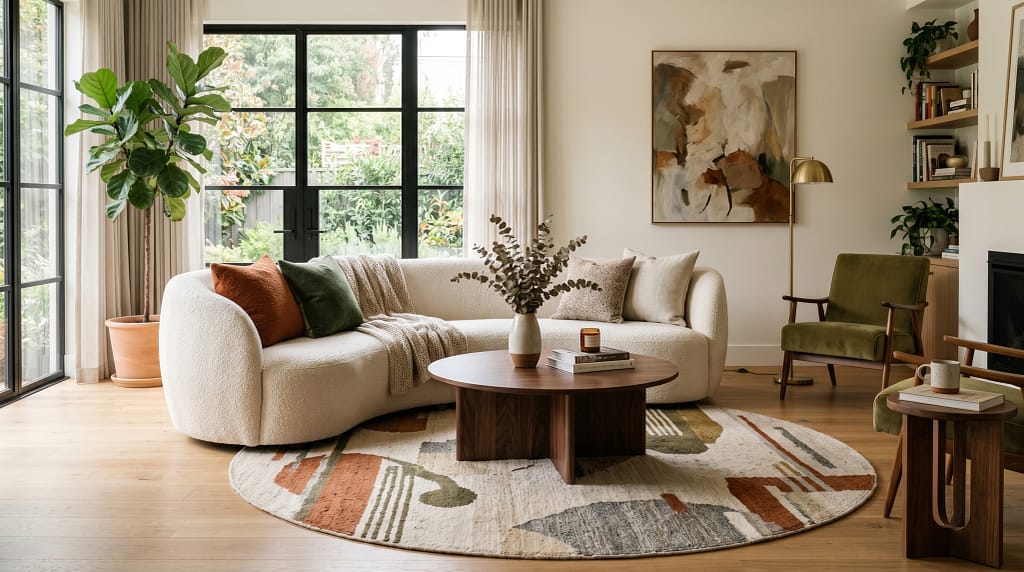
Pro tip: If you’re working with a smaller room, check out our guide to the best sofas for small living rooms – a crescent-shaped loveseat version of this layout works in rooms as small as 11 feet wide.
Layout 2: The Conversation Circle
Best for: Entertaining-focused rooms, large open spaces
This layout leans fully into the curved sofa’s natural strength: pulling people together. One of the best real-world examples of this layout is Cameron Diaz’s former living room in Montecito, which features a carefully arranged conversational seating layout combining curved armchairs and a curved sofa – the result is an on-trend yet understated effect that makes the room feel genuinely social.
The idea is to mirror the curve. Place your curved sofa on one side, then arrange two or three curved armchairs opposite it to complete the circle. A low round coffee table sits in the center, and the whole arrangement becomes a room within a room.
How to style it:
- Choose chairs that echo the sofa’s silhouette – tulip base or barrel-back styles work best
- Keep the coffee table very low (under 16 inches) so it doesn’t interrupt sight lines
- A statement pendant light directly above the table ties the circle together visually
Room size needed: This layout needs space. Budget at least 16 x 16 feet for it to breathe properly.
Layout 3: Open-Plan Zone Divider
Best for: Open-plan apartments, kitchen-living combos, studio flats
One of the most practical uses of a curved sofa – and one most people don’t think of. In an open-plan space, a curved sofa placed perpendicular to the kitchen or dining area creates a soft zone boundary without needing a wall, screen, or bookcase.
Instead of pushing furniture directly against walls, floating the curved sofa in the middle of the floor plan creates movement across the room and defines spaces naturally. Rounded silhouettes help larger living rooms feel less rigid and more intentional.
How to style it:
- Position the sofa with its back facing the kitchen or dining area
- Use a large rug on the living room side to reinforce the zone separation
- A low console table behind the sofa (against the curved back) doubles as a surface and visual barrier
What makes this work: The curved back of the sofa is more visually interesting than a straight sofa’s flat back – so it actually looks good from the kitchen side too.
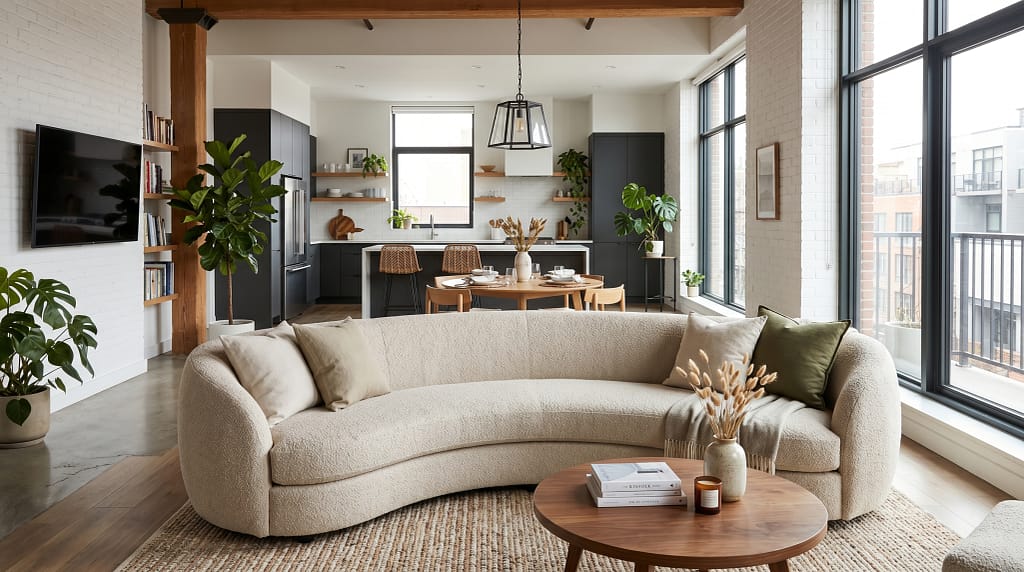
For open-plan spaces where a modular option might suit better, read our breakdown of modular sofas for small living rooms.
Layout 4: The Corner Crescent
Best for: Square rooms, rooms with an awkward corner, smaller spaces
A crescent or half-moon shaped curved sofa can tuck into the corner of a room in a way a standard sofa never could. Rather than running parallel to a wall, it angles inward – the two ends of the crescent point toward the room’s center while the curved back sits against the corner walls.
For open-plan rooms, ensure you still have at least 30 to 36 inches of circulation space behind or around the curved back so it feels inviting rather than squeezed. In a corner placement, this means leaving walkway space on at least one side.
How to style it:
- Choose a coffee table with a kidney or organic shape to complement the concave front
- Float a floor lamp in the corner behind one arm of the sofa – it fills the visual gap the sofa creates
- This layout works especially well with a TV mounted on the wall diagonal to the corner
Fabric note: Bouclé and velvet both work beautifully in a corner crescent layout – the texture adds visual weight that stops the sofa from disappearing into the corner.
Layout 5: Small Room Focal Point
Best for: Rooms under 14 feet wide that still want a curved sofa
The most common concern with curved sofas is that they’re only for large rooms. That’s not entirely true – but you do need to be strategic.
For smaller households, a single curved sofa plus a couple of chairs is easier to move and less visually dominant than a full rounded sectional. In a small room, skip the second seating piece entirely. Let the curved sofa be the only sofa and use one small accent chair instead of two full armchairs.
How to style it:
- Choose a sofa no longer than 84 inches (7 feet) end to end
- Go with a lighter fabric – cream, oatmeal, or pale sage – to stop the sofa dominating the space
- Use a slim, leggy coffee table (like a hairpin leg style) so the floor remains visible and the room feels larger
- Hang a large mirror on the wall opposite the sofa – it doubles the perceived depth of the room
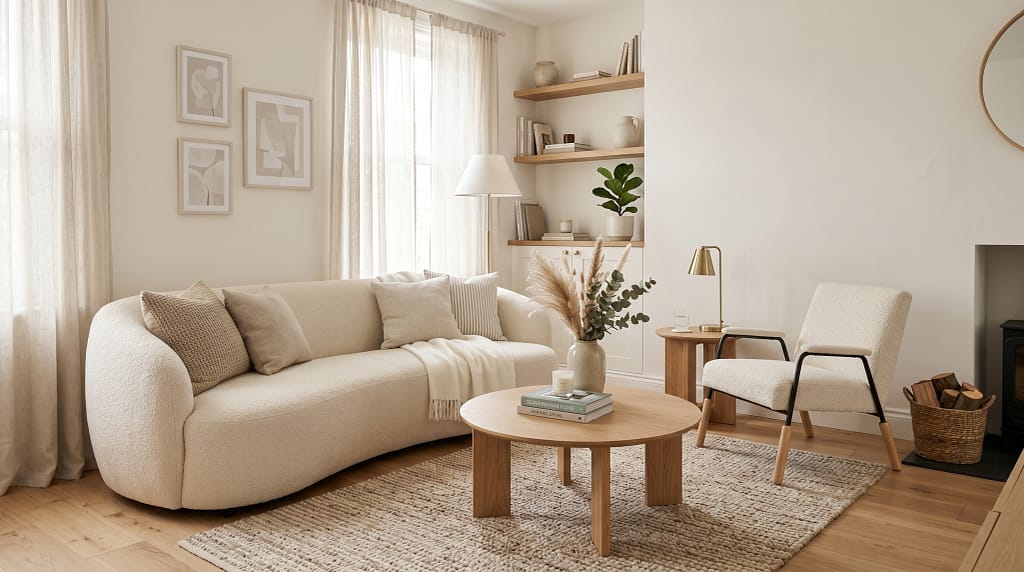
Compare your options first – our loveseat vs sofa guide covers whether a curved loveseat might be the smarter call for tighter spaces.
Layout 6: The Symmetrical Pair
Best for: Large, formal living rooms, rooms with a strong central focal point
This is the most dramatic curved sofa layout – two curved sofas facing each other across a central coffee table. Rounded sofa silhouettes that mirror each other across the room create a more formal conversation layout – the curved edges prevent the space from feeling rigid despite the strong symmetry, and cream upholstery balances saturated wall colors while keeping the arrangement bright.
It’s a layout borrowed from classic hotel lobbies and period-drama sitting rooms, and it works because the two curves create a visual oval in the center of the room that naturally frames whatever is between them.
How to style it:
- Both sofas should be identical or near-identical in silhouette – mixing styles here breaks the effect
- Use a large oval or round coffee table as the centerpiece between them
- Keep surrounding furniture minimal – this layout is already bold, it doesn’t need competition
- Works best in rooms 18 feet or longer end-to-end
Color tip: In 2026, dark neutrals like charcoal, ink, and espresso, along with inky blues and greens from moss to smoky jade, are the new quiet luxury neutrals for sofas – a pair of deep jewel-toned curved sofas facing each other is one of the most striking arrangements you can put together right now.
Layout 7: The Art Deco Statement
Best for: Maximalist interiors, rooms with strong architectural features
Metallic trim, carved table bases, and strong wall panels push a curved sofa arrangement toward a stronger Art Deco direction without losing softness – the curved edges prevent the space from feeling rigid despite the strong symmetry.
This layout pairs a single curved sofa with deliberately angular, geometric supporting pieces – a rectangular marble coffee table, tall architectural floor lamps, and bold wall art with clean geometric lines. The contrast between the sofa’s soft curve and the sharp surrounding elements is what makes the room feel intentional rather than accidental.
How to style it:
- Choose a curved sofa in velvet – emerald, midnight blue, or deep plum
- Pair with a rectangular marble or stone coffee table (the contrast works)
- Hang tall, narrow artwork in a symmetrical arrangement above the sofa
- Add brass or chrome accents through side tables, lamp bases, and cushion detail
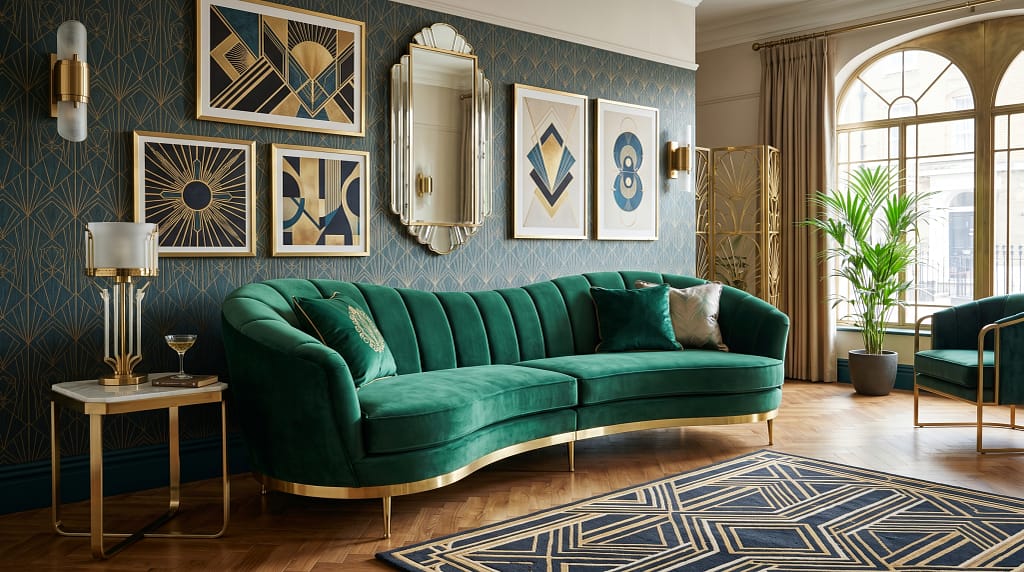
For more on the Art Deco interior trend taking over Pinterest in 2026, the team at Homes & Gardens has a great breakdown of how the organic-modern crossover is playing out in real homes.
What to Pair With a Curved Sofa
Regardless of which layout you choose, the furniture and accessories around your curved sofa follow the same rules:
Coffee tables: Always round or oval. Because the sofa itself is already a strong shape, the most sophisticated approach is to layer textures rather than competing shapes – round coffee tables echo the curve while rectangular ones create unnecessary visual tension.
Accent chairs: Avoid straight-backed, boxy chairs. Barrel chairs, tulip chairs, or any chair with a rounded silhouette keeps the room’s language consistent.
Rugs: Go large. A rug that’s too small under a curved sofa makes the whole arrangement look like it’s floating untethered. The rug should extend at least 6 inches beyond both arms of the sofa on each side.
Lighting: Velvet, bouclé, and performance linen are all excellent curved sofa upholstery choices in 2026 – accent pillows in complementary textures like chunky knit, silk velvet, and smooth cotton add visual richness without visual noise. Pair soft fabrics with warm light sources – floor lamps and table lamps rather than harsh overhead lighting.
What to avoid: Pairing curved sofas with tall, angular bookcases or large rectangular entertainment centers creates visual tension. Instead, choose low-profile side tables, streamlined accent chairs with rounded or tulip-shaped bases, and media consoles with a long, horizontal silhouette – the goal is a room that breathes.
Common Mistakes to Avoid
Even with the right layout, a few common errors can undermine the whole arrangement:
1. Pushing it against the wall This is the most common mistake. A curved sofa against a wall looks awkward because the arc creates a gap between the back of the sofa and the wall. Always float it, even by just a few inches.
2. Buying a size too small A small curve in a big room looks accidental. Go bold or go straight. If you’re not sure your room is large enough for a full curved sofa, a curved loveseat or crescent chair is a better call than a full sofa that looks undersized.
3. Ignoring traffic flow A curved sofa can block a walking path in a way a straight one does not. Before committing to a layout, walk the full path from every door in the room and make sure none of them are blocked by the sofa’s arc.
4. Wrong coffee table shape A rectangular coffee table in front of a curved sofa fights the shape rather than working with it. Round, oval, or organic shapes only.
5. Overcrowding the space A curved sofa is a statement piece. It doesn’t need three side tables, two floor lamps, and four accent chairs around it. Edit ruthlessly and let the sofa do the work.
Final Thoughts
Styling a curved sofa comes down to one core principle: treat it like the room’s focal point, not just one piece of furniture. Float it, give it breathing room, pair it with shapes that echo rather than fight its silhouette, and choose a layout that matches how you actually use the space.
Today’s curved sofas feel fresh because they use modern fabrics and proportions, but they follow a long design lineage from 1940s icons to 1970s showpieces – which means they’re more of a recurring classic than a passing fad. A well-chosen curved sofa will look current far beyond 2026.
Whether you go for the simple Classic Float or the dramatic Symmetrical Pair, the layouts above give you a framework that works in real rooms – not just staged showrooms.
Enjoyed this guide? Save it to your Pinterest boards and share it with anyone who’s been staring at their curved sofa wondering what went wrong.
Related posts you might like:




[…] more on building a full living room palette around a statement sofa, our guide to how to style a curved sofa covers layout and accessory combinations that work at every room […]
[…] more on building a room around a statement sofa with tapered legs, see our guide on how to style a curved sofa – curved sofas on tapered walnut legs are one of the most requested combinations in 2026 […]
[…] How to Style a Curved Sofa – 7 Living Room Layouts That Actually Work […]