

You can repaint a room, reupholster a sofa, and swap every cushion and rug – and still have the room feel flat if the lighting is wrong. Lighting is the one element that determines how every other decision looks. The right colour on your walls looks completely different under a cool-white overhead bulb versus a warm dimmed lamp. In fact, the most expensive sofa will look cheap under harsh, single-source light.
Lighting control – the ability to manage not just whether lights are on or off, but their brightness, warmth, direction, and layering – is the fastest and most affordable way to transform how a room looks and feels. In 2026, it has moved firmly into the mainstream. Instead of simply switching lights on and off, homeowners now want to control brightness and lighting mood individually. As a result, a single light fixture becomes a true lighting system.
This guide covers every lighting control idea worth knowing – from the foundational layering principles designers use in every project to the specific smart controls, dimmer setups, and fixture choices that make a real difference in a real room.
Table of Contents
Why Lighting Control Changes Everything
Most rooms have one lighting problem above all others: a single overhead source that is either fully on or fully off. This binary approach removes all nuance from a room. Furthermore, it flattens every material, texture, and colour in it.
Lighting Shapes the Room Before Anything Else
When lighting becomes part of the design story instead of an afterthought, the entire room is elevated. As a result, the homes that feel most effortlessly beautiful are almost always the ones where lighting has been considered as carefully as furniture and colour.
Lighting control is not a single product or system. Instead, it is an approach – a set of principles about how many sources of light a room needs, how they interact, and how their intensity should shift throughout the day. Once you understand those principles, the specific products become straightforward to choose.
What Good Lighting Control Does for a Room
Good lighting control delivers three specific outcomes:
- Changes the perceived size – well-placed accent lighting draws the eye to specific areas and makes a room feel larger and more deliberately arranged
- Improves every material in it – warm, controlled light makes wood richer, velvet deeper, and even painted walls look more saturated
- Controls mood as precisely as temperature – the ability to shift from bright task light to warm ambient glow is the single biggest quality-of-life upgrade most homes are missing
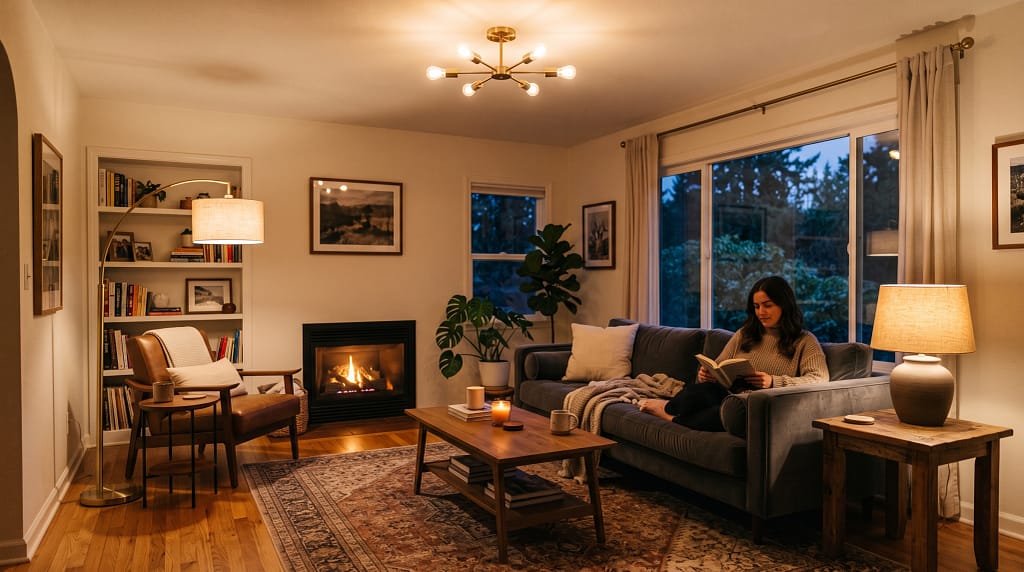
The Three Layers of Light – The Foundation of Every Good Room
Before any specific lighting control idea is worth discussing, this foundational principle matters most. Every well-lit room uses three distinct layers of light working together. Specifically, no single source does everything alone.
Layer 1 – Ambient Lighting
This is the room’s base illumination – the general, overall light that allows safe and comfortable movement. In most rooms, it comes from a ceiling fixture, downlights, or a central pendant. The mistake most people make is treating ambient light as the only layer and turning it to full brightness. Ambient light at full intensity flattens a room. However, at a lower, controlled level – achieved through a dimmer – it becomes a warm base that every other layer sits on top of.
Layer 2 – Task Lighting
Task lighting is directed light for a specific function – reading, cooking, working, or applying makeup. It is positioned close to where the task happens: a floor lamp beside an armchair, under-cabinet lighting in a kitchen, or a bedside reading lamp. It is brighter and more focused than ambient light, but limited to the zone where the function is happening.
Layer 3 – Accent Lighting
The most atmospheric layer of the three. Accent lighting highlights specific elements in the room – artwork, shelving, architectural features, and plants. It creates depth and visual interest by illuminating certain surfaces and leaving others in relative shadow. Consequently, this contrast is what makes a room feel professionally designed. Furthermore, adding dimmer switches or smart lighting to this layer lets you control the intensity depending on the time of day.
The Control Principle
Each layer should be independently controllable. A living room with all three layers wired to the same switch defeats the entire purpose. Therefore, the layers need to operate separately – and at different intensities – to give you genuine lighting control.
Dimmer Switches – The Cheapest Upgrade With the Biggest Impact
If there is one lighting control idea that delivers more value per pound or dollar than any other, it is the dimmer switch. It is inexpensive, requires no smart home system, and immediately transforms how a room can be used throughout the day.
Why Dimmers Make Such a Difference
A dimmed ceiling light at 30 percent in the evening creates a completely different room from the same ceiling light at full brightness during the day. Same fixture, same bulb, same room – entirely different atmosphere. This flexibility is exactly what most single-switch rooms are missing.
Where to Fit Dimmers First
- Living room ceiling or pendant – the highest-impact single dimmer installation in most homes
- Bedroom ceiling light – a bedroom at full brightness before sleep disrupts melatonin production; a dimmed ceiling light during the wind-down hour is both atmospheric and genuinely better for sleep
- Dining room pendant – a dimmed pendant above a dining table is the easiest way to make an everyday dinner feel like an occasion
What to Know Before Buying a Dimmer
- First, check that your existing bulbs are dimmable – LED bulbs specifically need to be rated for dimming, or they will flicker or buzz
- Additionally, trailing-edge dimmers work better with most modern LED bulbs than leading-edge technology – check the product specification
- Finally, most standard dimmer switches are a direct like-for-like replacement for a regular switch – a DIY task in under 30 minutes, or a very quick electrician job
Cost: A quality dimmer switch costs between £15 and £40 ($18 to $50) – making it one of the most affordable room upgrades available.
Smart Lighting Control – What It Actually Does
Smart lighting control takes the dimmer principle and adds two things: remote operation via app or voice, and the ability to create and save preset scenes that adjust multiple lights simultaneously.
The Practical Benefit
In practical terms, instead of walking around a room adjusting three separate lamps, you tap one preset on your phone and all three adjust simultaneously. You can also control your lights by voice via Google Home or Alexa, schedule lighting, and manage colour, brightness, and power – all from your phone. This is genuinely useful rather than just technically impressive.
The Most Practical Smart Lighting Control Options in 2026
Smart bulbs – the most accessible entry point. Replace standard bulbs with smart bulbs such as Philips Hue, LIFX, or Ikea Tradfri. Then control brightness and colour temperature via an app. No wiring changes are needed.
Smart dimmer switches – replace existing switches with smart dimmers. These control all bulbs on that circuit – not just smart bulbs – making them more cost-effective for rooms with multiple standard fittings. Brands like Lutron Caseta and Leviton are the most reliable options.
Smart plugs – the simplest option of all. Plug a table lamp or floor lamp into a smart plug and control it via app or voice without changing the bulb. This is especially useful for accent and task lighting layers.
Voice control integration – Amazon Alexa, Google Home, and Apple HomeKit all integrate with the major smart lighting brands. As a result, adjusting three light sources simultaneously with one phrase becomes a genuinely useful daily habit.
Where Smart Lighting Control Is Worth It
Smart lighting control adds real value in rooms you use frequently and in different ways throughout the day – primarily living rooms and bedrooms. In contrast, in a hallway or utility room, a standard dimmer is all you need.
Warm vs Cool Light – The Setting Most People Get Wrong
This is the lighting control decision that has the most immediate impact on how a room feels. Moreover, it is the one most people make incorrectly because they rely on whatever bulbs came with the fixtures.
Why Colour Temperature Matters
Bright, cool, blue-toned lighting is essential in hospitals and offices but is actively harmful to home atmosphere. In contrast, warmer tones enhance the look of textures, textiles, and even skin tones. Light colour temperature is measured in Kelvin (K):
- 2700K – 3000K: Warm white. Makes materials look richer, creates atmosphere, and is the correct choice for living rooms, dining rooms, and bedrooms
- 3500K – 4000K: Cool white. Clear and functional. Appropriate for kitchens and bathrooms where task accuracy matters more than atmosphere
- 5000K – 6500K: Daylight. Harsh in a domestic setting. Therefore, avoid this in any room where comfort matters
The Single Most Impactful Lighting Control Change
Replace every cool-white bulb in the living room, dining room, and bedroom with 2700K warm white equivalents. The cost is under £20 ($25) for a full set of bulbs. Furthermore, the difference is immediately visible and felt in every material in the room.
Additionally, warm-dimming bulbs go one step further. As they are dimmed, they shift toward an even warmer colour temperature, mimicking traditional incandescent bulbs. Consequently, this is the most atmospheric option for living rooms and dining rooms.
Lighting Control Room by Room
Each room in the home has a different lighting brief. Therefore, lighting control looks slightly different in each space. Here is how to approach each one.
Living Room Lighting Control
The living room is the most complex lighting control challenge in the home because it serves so many different functions – daytime reading, evening relaxation, entertaining, and watching TV. The ideal setup is a dimmable ceiling pendant as the ambient layer, a floor lamp beside the primary seating as the task layer, and one or two table lamps as supplementary accent sources. Critically, all three layers should be independently controllable and all should run on 2700K warm white bulbs.
For living rooms with a statement sofa as the focal point, see our guide to styling a neutral sofa – lighting is specifically covered as one of the tools that transforms a flat neutral room.
Bedroom Lighting Control
The bedroom needs two distinct lighting modes: bright and functional for getting dressed in the morning, and warm and dim for the wind-down hour before sleep. The ideal setup includes a dimmable ceiling light for functional brightness and two bedside lamps for warm, independent reading light. Additionally, a floor lamp in a corner adds accent atmosphere. Bedside lamps should be independently switched from the bed – wall-mounted swing-arm lamps or lamps with in-line switches are preferable.
Dining Room Lighting Control
The dining room has the simplest lighting brief of any room: one dimmable pendant directly above the table. A dimmed pendant above the dining table is the easiest way to make an everyday dinner feel like an occasion. Furthermore, the pendant should hang 70 to 80cm above the table surface for optimal light distribution without obstructing sight lines.

Kitchen Lighting Control
The kitchen needs the strongest task lighting of any domestic space. Food preparation requires accurate, bright light directly over the work surface. As a result, under-cabinet LED strips aimed at the countertop are the most effective solution. Additionally, a separate ambient ceiling circuit on a dimmer gives flexibility when the kitchen is used socially rather than functionally.
Home Office and Bathroom
For a home office, a desk lamp with a neutral-white bulb (3500K to 4000K) handles task accuracy. Separately, ambient lighting in the room at a warmer temperature stops the space feeling sterile. In the bathroom, a bright main light above the mirror serves the functional layer, while a secondary dimmable ceiling light or wall sconce provides a warmer, relaxation layer.
Statement Fixtures as Lighting Control Tools
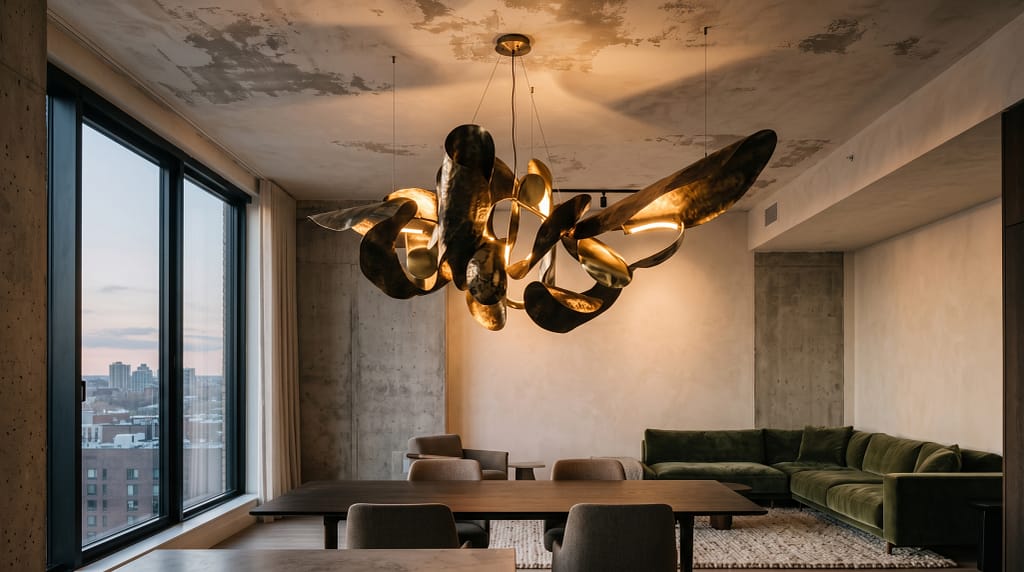
In 2026, statement light fixtures serve a dual function: they are both decorative objects and lighting control tools. Specifically, sculptural silhouettes are dominating, replacing wall art as focal points in hosting spaces.
How Statement Fixtures Control the Room’s Atmosphere
The direction in 2026 is toward fixtures that catch and diffuse light in distinctive ways rather than simply pointing a bulb at the ceiling. For example, alabaster and natural stone pendants produce a warm, honeyed ambient glow rather than direct light. Similarly, coloured glass chandeliers filter and tint the light itself, adding colour to a room without paint or textiles.
Furthermore, a sculptural pendant or chandelier is most effective when its light is dimmable and warm. An alabaster pendant at full brightness loses its atmospheric quality. However, dimmed to 40 to 60 percent, the stone glows and the light it produces becomes genuinely beautiful rather than merely functional.
Using Fixtures to Replace Artwork
The statement pendant can also replace other decorative elements. For instance, a striking chandelier above a dining table stands in for artwork, allowing the surrounding walls to stay calm and uncluttered. As a result, colour in lighting feels deliberate rather than trendy. The key is restraint – let the fixture be the statement, not every surface in the room.
For Neo Deco interiors specifically, a sculptural brass pendant with geometric facets is one of the most complete single-piece expressions of the trend. See our Neo Deco interior design guide for more on how lighting integrates with that aesthetic.
LED Strips and Indirect Lighting Control
LED strips are one of the fastest-growing areas in home lighting in 2026. Moreover, they are one of the most versatile and affordable lighting control tools available. They are integrated invisibly into furniture, niches, or ceilings to provide indirect warm light.
Why Indirect Light Works So Well
Indirect lighting – light that bounces off a surface rather than pointing directly into a room – is the technique that gives rooms their most atmospheric quality. For example, a cove ceiling with LED strips pointing upward creates a soft ceiling glow that adds enormous perceived height without any visible fixture.
The Most Effective LED Strip Placements
- Behind a TV screen – a warm-white LED strip on the back of a TV panel reduces eye strain and replaces the need for overhead lighting during viewing
- Under kitchen cabinets – aimed directly at the countertop, LED strips provide the best task lighting for food preparation
- Inside open shelving – warm-white strips inside shelving highlight objects and books, creating a display rather than a storage unit
- Cove or coffer ceiling details – LED strips in a ceiling recess pointing upward create an indirect ambient glow with no visible fixture and no glare
- Beneath floating furniture – a low-profile LED strip under a floating console or bed frame creates a floating effect that reads as expensive and intentionally designed
Colour Temperature for LED Strips
Always choose 2700K warm white for living and bedroom spaces. RGB colour-changing strips can be effective in accent applications, but they should be used with genuine restraint. In most cases, a subtle warm glow is far more effective than a saturated colour wash.
Cordless and Portable Lighting – The Flexible Control Option
One of the most practical and underrated lighting control developments in recent years is the rise of high-quality cordless lighting – rechargeable table lamps, floor lamps, and lanterns that require no power outlet.
Why Cordless Lamps Matter for Lighting Control
Battery life has improved dramatically. Furthermore, the designs have become smarter and more sculptural. Dining tables and sideboards benefit enormously from a cordless lamp – instant atmosphere without the fuss of trailing cables.
The key advantage is placement flexibility. Cordless lamps allow you to position a light source exactly where you need it – not where the nearest socket happens to be. Consequently, this is especially valuable for layered lighting in rooms where socket placement limits permanent lamp positions.
The Most Useful Cordless Lamp Placements
- A cordless lamp on a dining table as a centrepiece during dinner
- A portable lantern moved between a reading corner and a garden terrace depending on the season
- An accent lamp placed on an open shelf or in a corner alcove where no socket exists
- A bedside lamp on a partner’s side of the bed when rewiring would be required for a proper socket
Leading cordless lamp brands in 2026: Pooky, Blomus, and Hay all produce sculptural, rechargeable table lamps that integrate into high-end interiors without looking like camping equipment.
What Lighting Control Is Not
A few clarifications are worth making to avoid common misconceptions.
Lighting control is not the same as smart lighting. In fact, a simple dimmer switch gives you more lighting control than a fully smart system with no dimmers. The principle matters more than the technology.
More light is not better light. One of the most common over-corrections is adding more fixtures without thinking about control or layering. As a result, the room becomes brighter but no more atmospheric. Fewer, better-controlled sources almost always outperform many uncontrolled ones.
Colour-changing RGB lighting is not lighting control. RGB strips that cycle through colours can be fun in specific contexts. However, they have nothing to do with the atmospheric, layered approach that actually improves a room long-term.
Lighting control does not require a full rewire. Smart bulbs, smart plugs, cordless lamps, and floor lamps plugged into smart switches all give you meaningful lighting control without touching a single wire. The only genuine electrical work required is fitting dimmer switches, which is a simple replacement job.
Common Lighting Mistakes and How to Fix Them
Relying on one overhead light source – the most common mistake of all. Fix: add one floor lamp and one table lamp on separate switches or smart plugs. As a result, you immediately create two additional layers.
Using cool-white bulbs throughout – swap to 2700K warm white equivalents to instantly warm every material and surface. Cost: under £20 ($25) for a full set.
Fixtures that are too small for the room – a small pendant in a large room looks lost and provides neither adequate light nor adequate visual impact. Fix: as a rule, pendant diameter in inches should roughly match the room’s diagonal measurement in feet.
No lighting at floor level – most rooms light only the top half of the space. Therefore, a floor lamp or low accent light source brings the eye down to furniture and rug level and makes the room feel complete.
Pendant hung too high – a pendant over a dining table should hang 70 to 80cm above the surface, not close to the ceiling. A pendant hung too high loses both its atmospheric effect and its functional illumination.
All lights on the same switch – wiring all light sources to one switch removes all control. At minimum, main ceiling lights and supplementary lamps should be independently controlled. See our guide to living room colour palettes – every palette listed there depends on warm, layered lighting control to show its full quality.
Final Thoughts
Lighting is the only element in interior design that simultaneously affects how a room looks, how it feels, and how every other design decision performs. The right colour, the right sofa, the right rug – all of these work better under warm, layered, controlled light than under a single overhead source at full brightness.
Ultimately, lighting control in 2026 is about flexibility. Lighting should adapt to how you live, not the other way around. The goal is not complexity. Instead, it is the ability to shift a room from bright and functional at noon to warm and atmospheric at dusk – without getting up from the sofa.
Start with a dimmer switch on your living room ceiling light. Then add one floor lamp. Finally, switch every bulb to 2700K warm white. Those three changes cost under £60 ($75) total and will do more for your home than most furniture purchases ten times the price.
Loved this guide? Pin it to your home decor board and save it for the next time you are planning a room.
Related posts you might like:




[…] light from outside entering also prevents visibility from outside at night – when interior lighting would otherwise make the room clearly visible from the street. Blackout curtains provide full […]
[…] the defining window treatment trend of 2026 is pairing blinds and curtains from IKEA for better lighting and privacy control. The SKOGSKLÖVER is sheer, filters light without blocking it, and pairs […]
[…] lighting. The single most impactful cheap home decor change available costs under £20 and is almost always […]
[…] more on how lighting temperature transforms any space, see our lighting control […]
[…] lighting is essential with velvet sofas. Cool white light strips the richness from the pile and flattens the […]