

You fell for the dark sofa. Charcoal, black, deep navy, espresso – something with presence, something that wouldn’t show every mark, something that actually looked like a piece of furniture rather than a blank canvas. But your living room is bright. White walls, big windows, lots of natural light. And now you’re wondering if you just made a very expensive mistake.
You didn’t. A dark sofa in a bright room isn’t a clash – it’s one of the most reliable combinations in interior design when it’s done right. The fear that a dark sofa will “swallow” a light room comes from picturing it in isolation, without accounting for what’s actually proven to work around it.
This guide covers exactly how to make a dark sofa work in a bright room – the contrast rules, the materials, the lighting, and the specific mistakes that turn a striking dark sofa into a heavy, awkward one.
Table of Contents
- Why Dark Sofas and Bright Rooms Actually Work Together
- Rule 1: Let the Walls Do the Heavy Lifting
- Rule 2: Use Sheer Curtains, Not Heavy Drapes
- Rule 3: Ground It With a Pale Rug
- Rule 4: Cushions Are Your Contrast Tool
- Rule 5: Choose the Right Dark Shade for Your Light
- Rule 6: Pair With Warm Wood, Not Cool Metal
- Rule 7: One Sculptural Piece Above the Sofa
- Rule 8: Bring in Plants for Living Contrast
- Black vs Charcoal vs Navy vs Espresso – Which Dark Works Best in a Bright Room
- Common Mistakes That Make a Dark Sofa Feel Heavy
- Does a Dark Sofa Make a Small Room Feel Smaller?
- Final Thoughts
Why Dark Sofas and Bright Rooms Actually Work Together
The instinct to avoid dark furniture in a bright room comes from a reasonable but incomplete assumption: dark equals heavy, heavy equals less light, less light equals smaller-feeling room. In practice, the opposite is often true.
A dark sofa in a sun-filled room creates genuine visual contrast, and contrast is what makes a space feel intentional rather than flat. A charcoal sofa is the perfect grounding element in a crisp white room, adding contrast without overwhelming the airy feel – it doesn’t compete with the brightness, it defines it. Without something dark to anchor the eye, an all-white or all-pale room can actually feel washed out and shapeless, regardless of how much natural light it has.
The goal isn’t to fight the darkness of the sofa or hide it. It’s to let the room’s natural brightness do most of the work, then use the sofa as the one element that gives the space depth and weight.
Rule 1: Let the Walls Do the Heavy Lifting
If your sofa is dark, your walls are your biggest opportunity – and your biggest risk. Get this wrong and the whole room tips toward heavy. Get it right and the dark sofa looks deliberate and expensive.
Stick to white, off-white, warm cream, or very pale grey walls. These tones reflect the maximum amount of natural light back into the room, which directly counteracts the visual weight of the sofa. A charcoal sofa against white walls and a marble coffee table with a soft grey rug keeps everything clean and modern, while the contrast does the styling work for you.
If you want more color than plain white, pale sage, dusty blush, or the softest possible blue still work – as long as they stay light in value. The mix of colors in a room with a dark sofa – blush chair, warm wood, soft sage – keeps a space feeling fresh and inviting even when the anchor piece is genuinely dark.
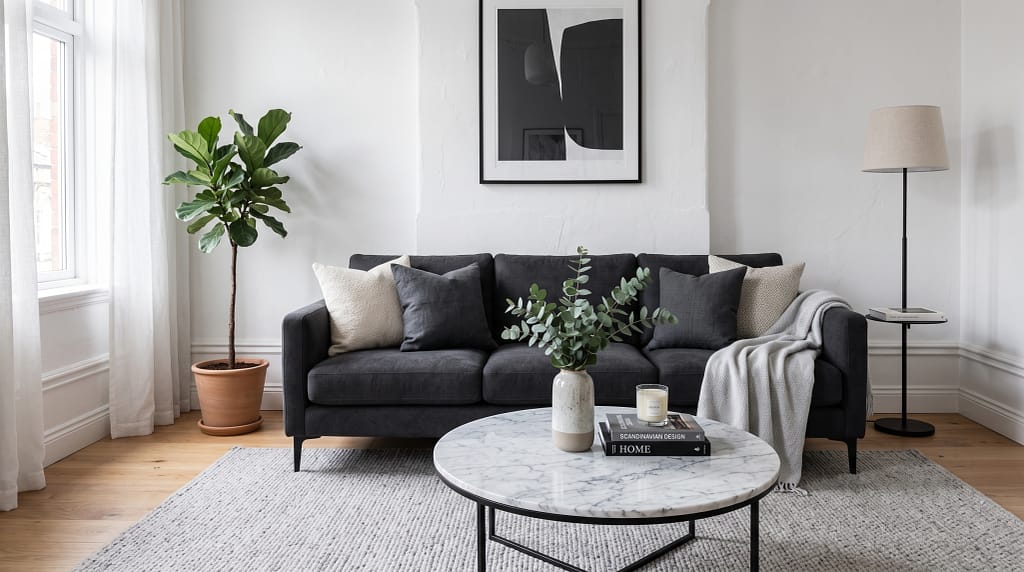
What to avoid: Painting the walls a mid-tone or darker color in the same room as a dark sofa, unless you’re intentionally going for a moody, enclosed look rather than a bright one. Two dark elements in the same small room compound rather than balance each other.
Rule 2: Use Sheer Curtains, Not Heavy Drapes
Window treatments matter more with a dark sofa than almost any other piece of furniture in the room, because they control how much of your room’s natural light advantage you actually get to keep.
A black sofa can still feel light and approachable when paired with creamy walls and sheer curtains that filter natural light, rather than blocking it. Heavy, lined drapes – especially in a dark or saturated color – remove exactly the brightness that’s doing the work of balancing your sofa.
The fix: swap to sheer linen or voile curtains in white or off-white. They still provide privacy and soften harsh direct sun, but they don’t sacrifice the diffused, even daylight that keeps a dark-sofa room feeling open rather than closed in.
If you need more privacy than sheers alone provide, layer a sheer panel with a light-colored roller blind rather than going straight to heavy drapery. You keep the light-filtering function without the visual weight.
Rule 3: Ground It With a Pale Rug
A dark sofa needs an anchor, but that anchor should not also be dark – that’s one of the fastest ways to accidentally create a heavy “block” of furniture that drags the eye down rather than around the room.
A soft grey or pale rug under a dark sofa creates contrast at floor level the same way white walls create contrast vertically. The rug becomes the bridge between the dark furniture and the light room, rather than another dark element competing for attention.
Material and color guidance:
- Light grey, oatmeal, or cream rugs work in nearly every dark-sofa room, regardless of the sofa’s exact shade
- A subtle pattern (soft abstract, light geometric) adds interest without darkening the overall tone
- Avoid dark or saturated rug colors directly under a dark sofa – it removes the contrast that’s doing most of the visual work
As with cushions and curtains, the principle holds throughout the room: light-colored fabrics and surfaces provide a neutral backdrop that allows the dark furniture to stand out as a deliberate, designed choice rather than visual clutter.
Rule 4: Cushions Are Your Contrast Tool
Cushions do double duty on a dark sofa: they break up a large block of solid dark color, and they’re the easiest, cheapest way to introduce exactly the right amount of brightness or warmth.
Simple black-and-white pillows add structure and a tailored edge against a dark sofa – a clean, classic approach that works in almost any bright room. For something warmer, tonal pillows in cream, taupe, and dusty rose against a navy sofa keep the look polished while softening the darkness with approachable, livable color.
The cushion formula for a dark sofa:
- 2-3 cushions in cream, ivory, or warm white – this is non-negotiable, it’s the core contrast that makes the dark sofa pop rather than disappear into shadow
- 1-2 cushions in a warm neutral (taupe, dusty rose, soft sand) for depth without losing brightness
- Optional: 1 cushion in mustard, gold, or rust for rooms that want warmth and a hint of richness – mustard velvet cushions and gold decor bring warmth and shine to a dark sofa beautifully
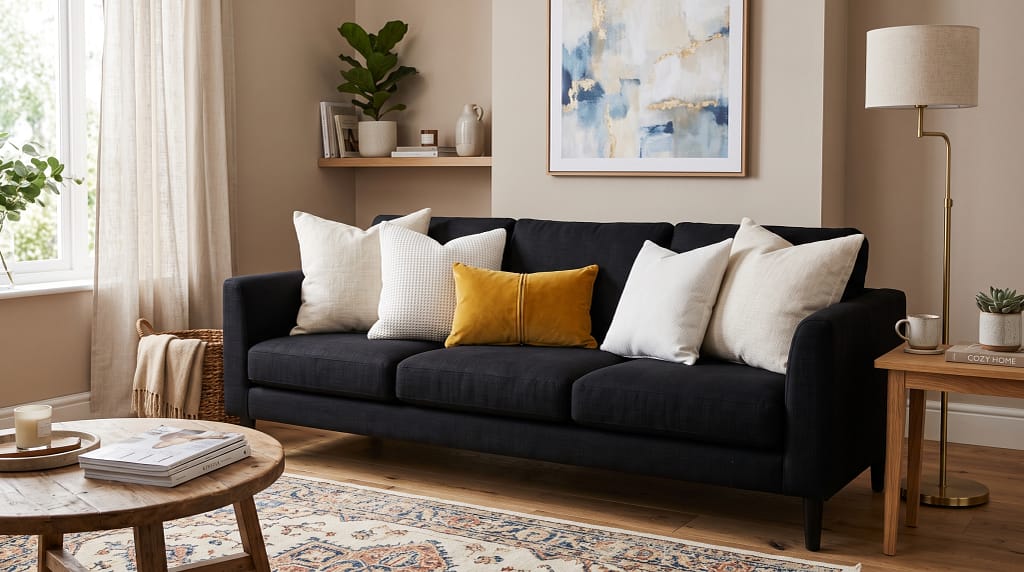
Avoid: dark or saturated cushion colors that match or are close to the sofa’s own shade. This removes the contrast and makes the sofa look like an undifferentiated dark mass rather than a styled piece.
Rule 5: Choose the Right Dark Shade for Your Light
Not all “dark sofas” behave the same way, and the specific shade matters more in a bright room than it would in a naturally dim one.
True black is the boldest option and reads as the most contemporary. It works best in rooms with abundant, consistent natural light – large windows, high ceilings, minimal obstruction. In rooms with less light, black can tip toward feeling like a void rather than a statement.
Charcoal grey is the most forgiving dark shade for a bright room. It has enough depth to ground the space without the starkness of true black, and it pairs effortlessly with both warm and cool accent colors.
Deep navy adds richness to a bright living room, especially when balanced with soft beige curtains and warm wood tones – it reads as sophisticated rather than heavy, and it has more visual warmth than black or charcoal because of its underlying blue tone.
Dark brown / espresso brings depth, warmth, and a sense of grounded luxury – it’s the warmest of the dark options and pairs naturally with creamy walls, warm wood, and airy textiles for a room that breathes even with a substantial dark anchor.
Forest or deep emerald green doesn’t whisper – it makes an entrance, anchoring a bright room with vintage glamour rather than heaviness, especially when paired with warm-toned cushions.
If your room gets strong, direct sunlight for most of the day, you can go as dark and saturated as you like – black or deep navy will look striking rather than oppressive. If your room is bright but the light is more indirect or diffused, charcoal or espresso will feel more balanced than true black.
Rule 6: Pair With Warm Wood, Not Cool Metal
The metal and wood tones you choose around a dark sofa change its entire emotional temperature. Dark furniture paired with cool-toned metals (chrome, brushed steel) tends to read as colder and more severe. Dark furniture paired with warm wood tones reads as grounded and inviting.
A dark sofa against warm wood flooring, with black lighting and clean-lined furniture, keeps the overall design feeling bright even in an open-plan layout – the wood is doing as much work as the white walls and pale rug in preventing the space from tipping into heavy.
Specific pairings that work:
- Oak or walnut coffee table instead of glass or chrome
- Brass or warm gold light fixtures instead of cool steel
- Rattan or wicker accent pieces (a basket, a pendant lamp) for organic texture against the smooth dark upholstery
- A wood slat feature wall, if you want to go further – the contrast between dark upholstery and warm wood creates a look that feels modern yet grounded
Rule 7: One Sculptural Piece Above the Sofa
Just like with neutral sofas, a dark sofa benefits enormously from one clear focal point rather than several competing accessories. With a dark sofa you don’t need to over-style everything – one strong focal point, paired with simple, thoughtful pieces, can carry the entire room.
The highest-impact options:
- An oversized mirror above the sofa – this is particularly effective in a bright room because it reflects and multiplies the existing natural light, directly counteracting the visual weight of the dark sofa below it
- A large abstract artwork in a light, airy palette – soft pinks, pale blues, cream tones – creates contrast with the dark sofa while staying in harmony with the room’s overall brightness
- A sculptural floor lamp beside the sofa, in a warm material like brass or rattan, adds height and visual interest without crowding the space

The discipline rule still applies: pick one. A dark sofa with white walls, a pale rug, and cream cushions already has plenty going on tonally – adding multiple competing focal points undoes the calm, intentional balance you’ve built.
Rule 8: Bring in Plants for Living Contrast
Greenery does for a dark sofa what it does for a neutral one, but with even more impact – the contrast between deep, saturated upholstery and fresh green leaves is one of the most naturally pleasing color pairings in interior design.
Plants and pampas grass bring a touch of life to a dark-sofa space, especially when paired with warm candlelight and woven textures that soften the overall look. In a bright room specifically, plants also benefit from the abundant natural light, so they’ll genuinely thrive rather than just survive – a practical bonus on top of the styling one.
Best options near a dark sofa in a bright room: a large fiddle leaf fig or rubber plant for height and presence, a trailing pothos on a high shelf, or a cluster of smaller plants on a windowsill to extend the greenery throughout the room rather than isolating it in one corner.
Black vs Charcoal vs Navy vs Espresso – Which Dark Works Best in a Bright Room
| Shade | Best for | Pairs best with | Mood |
|---|---|---|---|
| True black | Rooms with abundant, direct natural light | White walls, brass accents, sheer curtains | Bold, contemporary, graphic |
| Charcoal grey | Almost any bright room – the most forgiving option | Marble, soft grey rug, mixed metals | Modern, clean, versatile |
| Deep navy | Bright rooms wanting warmth without going brown | Beige curtains, warm wood, dusty rose cushions | Sophisticated, calm, rich |
| Espresso brown | Bright rooms with a lot of natural materials already | Cream walls, rattan, airy textiles | Warm, grounded, cozy |
| Forest green | Bright rooms wanting a statement that isn’t black | Warm-toned cushions, eclectic decor, brass | Vintage glamour, expressive |
Common Mistakes That Make a Dark Sofa Feel Heavy
A few specific errors are responsible for almost every “my dark sofa makes the room feel smaller” complaint:
Pairing it with heavy drapes. As covered in Rule 2 – this single change removes more brightness than almost anything else on this list.
Matching the rug to the sofa. A dark rug under a dark sofa doubles the visual weight in one zone of the room instead of spreading contrast throughout it.
Skipping the cushions. A solid block of dark upholstery with no contrasting cushions reads as unfinished and heavier than the same sofa styled properly.
Choosing cool-toned accessories. Chrome, glass, and cool grey accents next to a dark sofa can tip a room from “grounded” into “cold,” even with plenty of natural light.
Placing it in the darkest corner of the room. Even in an objectively bright room, a dark sofa pushed into the one corner that gets the least light will look heavier than the same sofa positioned to catch more of the room’s natural light throughout the day.
Going dark on too many surfaces at once. One dark sofa is a statement. A dark sofa plus dark curtains plus a dark rug plus dark walls is a different room entirely – intentional if that’s the goal, but not what “dark sofa, bright room” is going for.
Does a Dark Sofa Make a Small Room Feel Smaller?
This is the question behind most of the hesitation around dark sofas, and the honest answer is: it depends far more on what surrounds the sofa than on the sofa’s color alone.
A dark sofa in a small room with white walls, a pale rug, sheer curtains, and good natural light will not meaningfully shrink the perceived size of the space – the contrast principle still applies regardless of square footage. What does shrink a small room is dark sofa plus dark walls plus heavy curtains plus minimal light, regardless of the room’s actual dimensions.
If you’re working with a smaller space and want the safety net of a lighter palette while still getting a grounding, anchoring piece of furniture, our guide to styling a neutral sofa covers the same contrast principles in reverse – useful if you’re still deciding between a dark and a neutral sofa for a compact room.
Final Thoughts
A dark sofa in a bright room isn’t a risk – it’s one of the more reliable formulas in interior design, as long as the room around it is doing its job. White or pale walls, sheer curtains, a light rug, contrasting cushions, warm wood tones, and one clear focal point are the ingredients that let a dark sofa read as deliberate and elevated rather than heavy.
The sofa was never going to be the problem. Like most furniture styling questions, the answer lives in everything around it – and once that’s in place, a dark sofa in a bright room isn’t something to second-guess. It’s the detail that makes the whole space look finished.
Loved this guide? Pin it to your living room board for the next time you’re second-guessing a dark sofa.
Related posts you might like:
- The Lazy Girl’s Guide to Styling a Neutral Sofa Without It Looking Boring
- Velvet Sofa Colors That Are Trending in 2026
- How to Style a Curved Sofa – 7 Living Room Layouts That Actually Work
- Sofa Leg Styles Explained – How Furniture Legs Change the Whole Room




[…] more on how this pairs with your overall room palette, our guide to dark sofas in bright rooms covers leather specifically in sun-exposed […]