

Every sofa fabric looks good in the showroom. Under retail lighting, on a frame nobody’s actually sat on, next to a price tag that makes the decision feel simple. Then it comes home – to a toddler with toast, a dog that sheds, a daily routine that doesn’t care how the fabric looked under showroom spotlights.
This is the question that actually matters: which sofa fabric is worth buying in 2026, once you account for how people actually live with it?
The answer isn’t one single “best” fabric – it depends on your household. But there is a clear, ranked hierarchy once you separate marketing claims from real durability data, lab testing, and large-scale owner surveys. This guide ranks every major sofa fabric using the metric that matters most: how it performs over years of actual use, not how it photographs on day one.
Table of Contents
- How Sofa Fabric Durability Is Actually Measured
- The Ranking – Sofa Fabrics from Best to Worst Value
- Full-Grain Leather – The Longevity Champion
- Performance Fabric – The Smartest All-Round Choice
- Top-Grain Leather – Most of the Benefit, Less of the Cost
- Microfiber – Best for Pets and Tight Budgets
- Wool and Wool-Blends – The Surprise Top Performer
- Polyester and Polyester Blends – The Reliable Middle Ground
- Velvet (Performance) – Worth It If You Choose Right
- Bouclé and Chenille – Beautiful but High-Maintenance
- Linen – Gorgeous, but Be Honest About Your Lifestyle
- Cotton – Soft, but the Weakest Long-Term Pick
- Avoid This One: Faux Leather
- Best Fabric by Household Type
- What the Rub Count Numbers Actually Mean
- Final Thoughts
How Sofa Fabric Durability Is Actually Measured
Before ranking anything, it helps to know what “durable” is actually measuring. The industry standard is the Martindale rub count (often shortened to “double rubs”) – a lab test that rubs a fabric sample against an abrasive surface and counts how many cycles it survives before visible wear appears.
As a rough guide, industry guidance suggests 15,000+ double rubs is ideal for heavily used furniture such as family-room sofas, while 9,000-15,000 is generally durable enough for less busy households. For homes with kids or pets, the bar moves higher still – aim for 30,000 rubs minimum, and 50,000+ if you’re dealing with heavy shedders or rough use.
But rub count is only part of the story. Double rubs measure abrasion resistance, but they don’t tell you how a fabric will recover after sitting, whether it will pill, or how it will age over years of use – which is why a moderately rated fabric with strong fibers and good construction often outperforms one with extreme abrasion numbers and poor recovery.
This ranking weighs four factors together: lab-tested durability, real-world owner survey data, ease of cleaning and maintenance, and total cost-per-year of ownership – not just sticker price.
The Ranking – Sofa Fabrics from Best to Worst Value
| Rank | Fabric | Lifespan | Rub Count | Best For |
|---|---|---|---|---|
| 1 | Full-grain leather | 15-25+ years | N/A (leather rated differently) | Long-term investment, no pets/minimal shedding concern |
| 2 | Performance fabric | 10-18 years | 20,000-40,000+ | Families, pets, busy households |
| 3 | Top-grain leather | 12-20 years | N/A | Premium feel, smaller budget than full-grain |
| 4 | Microfiber | 8-15 years | 30,000-50,000 | Pets, tight budgets, easy cleaning |
| 5 | Wool & wool-blends | Long-rated by owners | High real-world durability | Households wanting natural fiber that lasts |
| 6 | Polyester blends | 7-12 years | 15,000-30,000 | Reliable, budget-friendly all-rounder |
| 7 | Performance velvet | Varies by weave | ~40,000 | Style-focused households willing to choose wisely |
| 8 | Bouclé & chenille | Moderate | 20,000-40,000 | Texture lovers, low-shedding pets only |
| 9 | Linen | 5-10 years | Moderate | Breathability and look over maximum durability |
| 10 | Cotton | 5-10 years | Lower | Budget, low-traffic, formal rooms |
| Avoid | Faux leather | 3-7 years | N/A | Not recommended for daily-use sofas |
1. Full-Grain Leather – The Longevity Champion
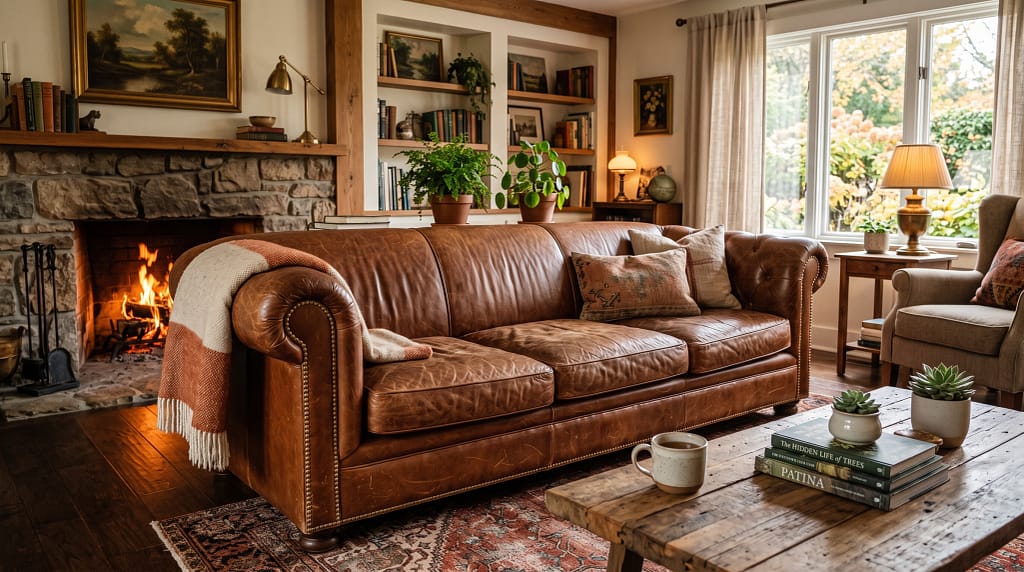
If pure lifespan is the only metric that matters to you, leather wins decisively. Full-grain leather offers 15 to 25+ years of life with unrivaled structural integrity, and statistically, leather can be four times tougher than standard woven fabrics. Leather wins the longevity battle by a significant margin of roughly 10 years over its closest fabric competitor.
Part of leather’s advantage is structural rather than surface-level: it does not hold dust mites or pet dander, which can break down fabric fibers from the inside out over time the way woven upholstery does.
The trade-off: leather requires actual maintenance, not just occasional cleaning. Scratches show, and sunlight can deepen or darken the tone unevenly – conditioning is part of ownership, not an optional step. Leather should be conditioned roughly every 12 months to prevent drying and cracking, especially in low-humidity environments.
Best for: Households without aggressive pet scratching, rooms out of direct intense sunlight, anyone planning to keep the sofa 15+ years. Not ideal for: Homes with cats (claws and leather are a bad combination) or rooms in constant direct sun.
For more on how this pairs with your overall room palette, our guide to dark sofas in bright rooms covers leather specifically in sun-exposed spaces.
2. Performance Fabric – The Smartest All-Round Choice
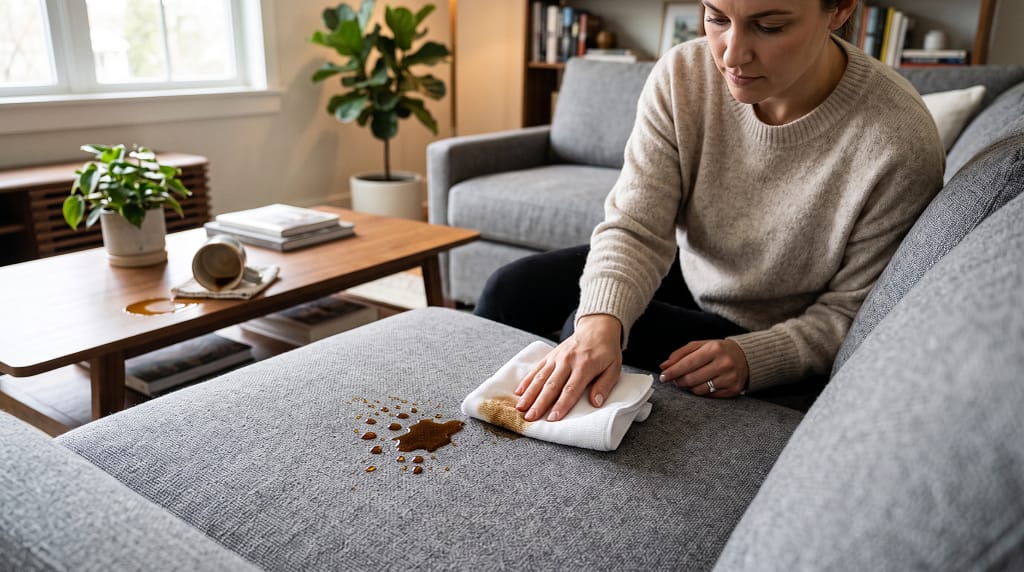
For most households in 2026, this is genuinely the best-value pick on the list. Performance fabric (brands like Crypton and Sunbrella lead this category) is engineered specifically to resist stains, moisture, and abrasion at a level natural fibers can’t match.
Stain resistance approaches legendary status, repelling over 90 percent of common household threats including red wine, coffee, pet accidents, and food spills – most messes wipe clean with a damp cloth and mild detergent, eliminating the anxiety that accompanies light-colored upholstery. That last point matters more than people expect: performance fabric is what makes a white or cream sofa realistic for a family with young kids.
Rated lifespan sits at 10 to 18 years, with rub counts commonly tested to 20,000 or even 40,000+ cycles in premium lines. Versatility extends to indoor and outdoor applications too, since many performance fabrics resist moisture, mildew, and UV fading equally well in both environments – useful if your living room has floor-to-ceiling windows or a lot of direct sun.
Best for: Families with kids, pet owners, anyone who wants to stop being precious about their sofa. Watch for: Quality varies significantly across the “performance fabric” category – look specifically for tightly woven construction and a stated rub count above 20,000, not just the word “performance” on the tag.
3. Top-Grain Leather – Most of the Benefit, Less of the Cost
Top-grain leather sits just below full-grain in the hierarchy, offering an excellent balance of soft feel and toughness with a 12 to 20 year lifespan. It’s sanded and treated more than full-grain, which gives it a more uniform, consistent appearance – some people prefer this look, others prefer full-grain’s more natural, characterful surface.
It carries all the same core advantages as full-grain – resistance to dust mites and dander, natural fire resistance, and elasticity that prevents the sagging fabric sofas can develop over time – just with a slightly shorter total lifespan and typically a lower price point.
Best for: Buyers who want leather’s durability and easy cleaning without the full-grain price tag. Not ideal for: The exact same pet and sun-exposure caveats as full-grain leather apply here too.
4. Microfiber – Best for Pets and Tight Budgets
Microfiber punches well above its price point on this list. Its tight, non-woven structure prevents claws from snagging and makes it incredibly easy to remove pet hair and dander – for households where the dog or cat owns the sofa as much as the humans do, this is a genuinely strong practical choice.
With rub counts commonly in the 30,000-50,000 range and a realistic 8 to 15 year lifespan, microfiber holds up far better than its budget price point suggests. Its tightly-woven fibres also make it a stain-fighting, colour-holding champion compared to many natural fiber alternatives.
Best for: Pet owners (especially dogs), tight budgets, kids’ playrooms or casual family spaces. Not ideal for: Households wanting a natural-fiber feel or a more luxurious hand-feel – microfiber reads as practical rather than premium.
5. Wool and Wool-Blends – The Surprise Top Performer
This is the fabric most “best sofa fabric” lists underrate, and the real-world data is striking. In a large-scale survey of over 1,300 sofa owners, wool and wool-blends emerged as the most durable sofa materials, with less than a quarter of owners reporting any signs of damage or wear – outperforming several fabrics with higher lab-tested rub counts.
This is a good reminder that lab numbers and lived experience don’t always match perfectly. Wool’s natural fiber structure resists crushing and recovers its shape well after repeated use, which is part of why long-term owner satisfaction outpaces what a rub-count number alone would predict.
Best for: Households wanting a natural fiber with genuinely excellent long-term durability, not just a “natural and breathable” marketing claim. Watch for: Wool can be pricier than synthetic alternatives and benefits from occasional professional cleaning to maintain its appearance.
6. Polyester and Polyester Blends – The Reliable Middle Ground
Polyester is the quiet workhorse of the sofa fabric world. It’s highly stain-resistant and durable, with a realistic 7 to 12 year lifespan and rub counts typically in the 15,000-30,000 range – solidly within the “good for daily family use” zone without performance-fabric pricing.
Polyester and olefin are frequently favored as budget-friendly, durable, stain-resistant options precisely because they deliver dependable performance without asking for premium prices or special maintenance routines.
Best for: Households wanting reliable, no-fuss durability on a moderate budget. Not ideal for: Anyone prioritizing a natural-fiber feel or breathability over practicality – polyester can feel less breathable than cotton or linen in warm climates.
7. Performance Velvet – Worth It If You Choose Right
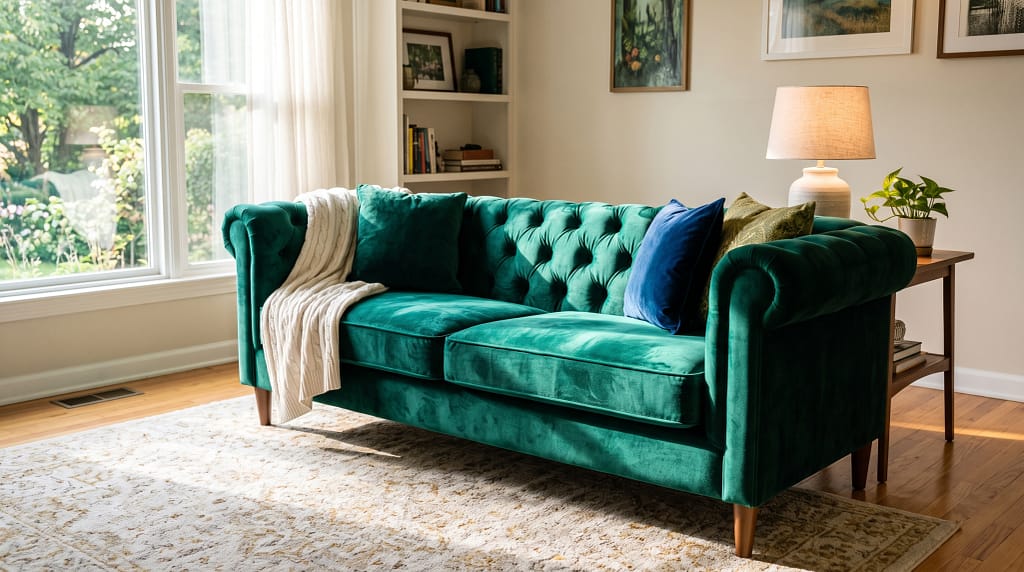
Velvet earns a more nuanced ranking than it usually gets. Modern polyester performance velvet is surprisingly tough – it resists pilling and holds colour well, with rub counts sitting around 40,000, which is genuinely respectable for daily use. The key differentiator with performance velvet specifically is that it’s engineered to resist stains and wear while keeping velvet’s signature plush, light-catching look, making it surprisingly viable for everyday family life rather than just formal, low-traffic rooms.
Velvet is also excellent at hiding minor wear because light reflects differently across the pile, adding depth and richness to the sofa’s surface rather than showing flat, even wear the way some fabrics do.
The trade-off to know about: velvet can show pressure shading and direction changes where the pile gets brushed differently by sitting and movement – some people love this as part of the lived-in look, others find it distracting. If you prefer a more uniform appearance, choose a velvet with a shorter, denser pile and a more matte finish.
For more on choosing the right velvet shade for your room, see our guide to velvet sofa colors trending in 2026.
Best for: Style-focused households willing to specifically seek out performance-rated velvet rather than traditional velvet. Avoid: Traditional (non-performance) velvet for heavy shedders – hair embeds at the fibre base and takes serious effort to remove.
8. Bouclé and Chenille – Beautiful but High-Maintenance
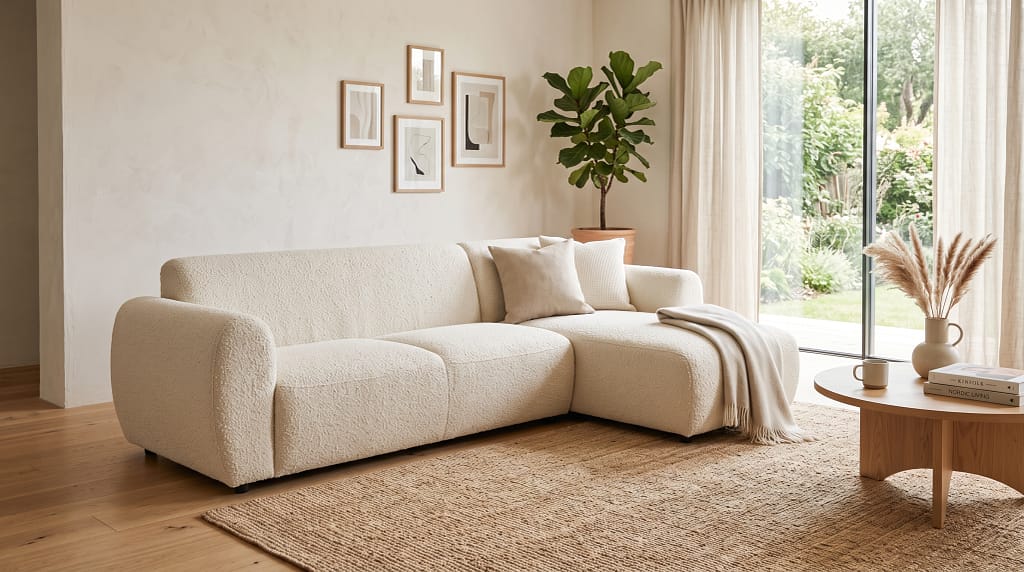
Bouclé has been one of the defining textures of the past few years, and chenille offers a similarly soft, fuzzy, plush feel. Both are genuinely lovely to sit on and photograph beautifully – but they come with real durability trade-offs worth knowing before you commit a full sofa budget to them.
Chenille typically scores 20,000 to 40,000 rubs, which sounds respectable, but it also snags easily and attracts pet hair more readily than tighter weaves. Bouclé shares this vulnerability – its looped, textured surface is exactly what makes it visually interesting, and exactly what makes pet hair and debris difficult to fully remove.
Best for: Style-focused, lower-traffic rooms, households without heavy-shedding pets. Not ideal for: Homes with dogs or cats that shed significantly, or households wanting a wipe-clean, low-maintenance fabric.
9. Linen – Gorgeous, but Be Honest About Your Lifestyle
Linen has an effortless, high-end casual look that’s hard to replicate with synthetic alternatives, and it’s genuinely a strong natural fiber – linen is more durable than cotton, with a relaxed, breathable finish. But it comes with two honest caveats: linen wrinkles and can show wear patterns over time, and like most natural fibers, it’s less stain-resistant than performance alternatives.
Realistic lifespan sits at 5 to 10 years, which is respectable but noticeably shorter than leather, performance fabric, or wool. Many linen sofas today use linen-poly blends specifically to address this – keeping linen’s breathable, natural look while adding some of the resilience and stain resistance pure linen lacks.
Best for: Households prioritizing breathability and a relaxed, natural aesthetic over maximum durability, especially in warmer climates. Watch for: If choosing pure linen rather than a blend, expect to actively manage wrinkling and be more cautious about spills than you would with performance fabric.
10. Cotton – Soft, but the Weakest Long-Term Pick
Cotton feels familiar and easy, which is part of its enduring appeal, but it ranks lowest among the natural and synthetic fibers commonly used for sofas. Cotton can wear and fade faster in high-traffic use, and lighter colors can stain more easily unless the fabric is treated – both meaningful drawbacks for a piece of furniture used daily.
Realistic lifespan is in the 5 to 10 year range, similar to linen, but with generally lower durability ratings and faster visible wear in busy households. Cotton-poly blends are commonly used to offset this, adding resilience and stain-resistance while keeping much of cotton’s soft, familiar hand-feel.
Best for: Low-traffic formal living rooms, guest rooms, or budget-conscious purchases where a shorter lifespan is an acceptable trade-off. Not ideal for: Main family sofas in busy households – this is the fabric most likely to show its age within a few years of daily use.
Avoid This One: Faux Leather
This is the one fabric on this list with a genuinely clear “skip it” recommendation, backed by large-scale owner data. In a survey of over 1,300 sofa owners, faux leather sofas were far more damage-prone than any other type, with over half of owners reporting visible signs of damage or wear – a statistically significant gap compared to every other material tested.
The reason is structural: faux leather consists of a thin plastic film layered over a fabric backing, and because that film is so thin, it can easily crack and wear over time, start to peel and lift, or develop holes that reveal the backing underneath. Unlike genuine leather, which develops a desirable patina with age, faux leather simply deteriorates.
Bottom line: if budget is the concern that’s pulling you toward faux leather, a well-chosen performance fabric or microfiber sofa will outlast it significantly at a similar or even lower price point.
Best Fabric by Household Type
Have a dog? Microfiber or performance fabric – both resist hair embedding and clean up quickly with a vacuum or damp cloth.
Have a cat? Tightly-woven performance fabric or microfiber. Avoid velvet, bouclé, and chenille – their textured, loose-fiber surfaces give claws something to hook into.
Have young kids? Performance fabric is the clear winner – the stain resistance alone removes most of the daily anxiety, and the durability holds up to jumping, spills, and constant use.
Furnishing a formal, low-traffic room? This is where linen, cotton, or traditional (non-performance) velvet genuinely make sense – their durability limitations matter far less when the sofa isn’t seeing daily heavy use.
Want the longest possible lifespan and don’t mind maintenance? Full-grain leather, hands down – nothing else on this list comes close on pure longevity.
Want natural fiber without sacrificing durability? Wool or a wool-blend – the real-world owner data on this one is genuinely the most surprising finding in the durability research, and it deserves more attention than it usually gets.
What the Rub Count Numbers Actually Mean
When you’re comparing fabric labels in store, here’s a simple translation of the numbers you’ll see:
- Under 15,000 rubs: Suitable for low-traffic, occasional-use furniture – guest rooms, formal sitting rooms.
- 15,000-30,000 rubs: Generally durable enough for regular family use in moderately busy households.
- 30,000-50,000+ rubs: Built for heavy daily use – ideal if you have kids, pets, or a sofa that functions as the true center of your home.
But rub count alone isn’t the whole picture – it measures abrasion resistance, not recovery, pilling resistance, or long-term colorfastness. The most reliable approach is to combine the rub count with the fabric category’s known real-world track record (covered throughout this ranking) rather than relying on the number in isolation.
A practical tip echoed across nearly every source in this space: order fabric samples and live with them for a week before committing to full upholstery yardage, testing how they actually respond to your household’s specific conditions – sunlight, pets, kids, daily use – rather than judging from a swatch under store lighting.
For more on how fabric choice interacts with the frame and legs of your sofa, our guide to sofa leg styles covers the other structural decisions worth getting right before you buy.
Final Thoughts
There’s no single “best” sofa fabric – there’s a best fabric for your specific household, and the data makes that ranking genuinely clear once you separate marketing language from real performance. Full-grain leather wins on pure longevity. Performance fabric wins on practical, everyday value for busy families. Wool quietly outperforms expectations in real-world owner satisfaction. And faux leather is the one category worth actively avoiding, regardless of budget.
The fabric you choose is the part you’ll touch every single day, and it’s also the first thing to reveal wear – which makes it worth more research time than the color or the silhouette, even though those are usually what catches your eye first in the showroom. Match the fabric to how your household actually lives, not to how the sofa looks under store lighting, and it will still look intentional years from now rather than tired.
Loved this guide? Pin it to your living room board for the next time you’re sofa shopping.
Related posts you might like:




[…] more guidance on choosing the right sofa fabric before you buy, see our complete sofa fabric ranking – it covers every major fabric type ranked by real owner durability […]
[…] For a complete comparison of how velvet ranks against every other sofa fabric in a data-backed durability ranking, see our sofa fabrics ranked guide. […]