

You went with the safe sofa. Beige, oatmeal, greige, soft grey – something that wouldn’t clash with anything, wouldn’t date quickly, wouldn’t be a problem if you changed your mind about the rest of the room later. Smart move.
Except now the room feels a little flat. A little hotel lobby. And you don’t have the time, money, or energy to start over.
Good news: you don’t need to start over. A neutral sofa is one of the most forgiving pieces of furniture you can own – it works across seasons, styles, and moods – but the thing that makes it flexible is also the thing that makes it boring if you stop one step too early. The fix isn’t color. It’s everything else.
This is the lazy girl’s guide to styling a neutral sofa: maximum visual impact, minimum effort, no need to touch the sofa itself.
Table of Contents
- Why Neutral Sofas Look Boring (and It’s Not the Color)
- Rule 1: Texture Is Doing All the Work
- Rule 2: The Cushion Formula That Actually Works
- Rule 3: One Throw, Styled Properly
- Rule 4: Let the Rug Do the Anchoring
- Rule 5: One Bold Thing, Not Five Small Things
- Rule 6: Match Your Undertone Before You Buy Anything
- Rule 7: Bring the Outside In
- The 15-Minute Styling Routine
- What NOT to Do to a Neutral Sofa
- Is a Neutral Sofa Still a Good Investment in 2026?
- Final Thoughts
Why Neutral Sofas Look Boring (and It’s Not the Color)
Here’s the thing nobody tells you when you’re choosing between beige and “literally anything else”: a neutral sofa doesn’t fail because it lacks color. It fails because everything around it is doing the same flat, single-texture thing the sofa is doing.
A neutral palette does not need bold color to feel interesting – it needs contrast. Layer different textures to create depth, because even within the same color family, texture is what stops the space from feeling flat. If everything feels the same to the touch, it ends up looking the same to the eye.
That’s really the whole secret. A “boring” neutral sofa is almost always a styling problem, not a color problem. Fix the layering and the sofa instantly reads as intentional instead of incomplete.
Rule 1: Texture Is Doing All the Work
If you only do one thing from this entire guide, do this one.
Texture is what stops a neutral room from feeling like a hotel lobby. Mixing a woven throw with a velvet cushion creates shadows and highlights on the sofa that make the furniture look considerably more expensive than it actually is.
The physics of this is simple: a velvet cushion catches light and looks bright; a woollen or bouclé throw absorbs light and looks deeper. That contrast between matte and shine, smooth and chunky, is what gives a neutral room its designer feel – without spending designer money.
The “opposites attract” rule: if your sofa fabric is smooth (velvet, linen, leather), bring in something rough and chunky-knit. If your sofa fabric is already textured (bouclé, tweed, a heavier weave), go sleek and smooth with your cushions and throw instead. Two textures of the same type cancel each other out – you need contrast, not matching.
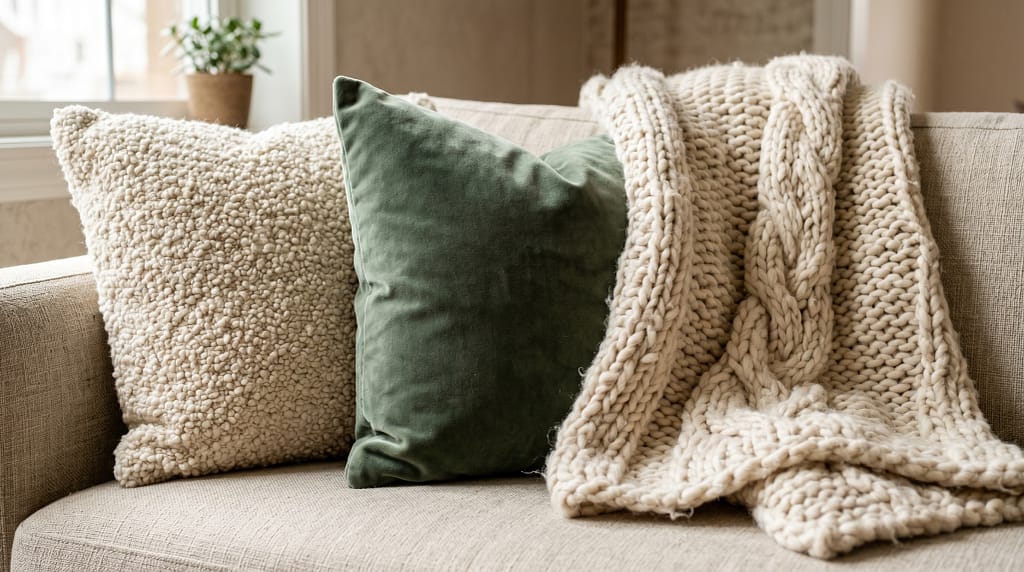
Quick texture shopping list for a neutral sofa:
- A bouclé or sherpa cushion
- One smooth velvet cushion
- A chunky open-knit throw
- A woven jute or rattan basket nearby for visual material variety
- A ribbed or fluted ceramic vase on the coffee table
Rule 2: The Cushion Formula That Actually Works
Cushions are where most sofas either come together or fall apart, and most people get the math wrong. Either too few (the sofa looks unstyled) or too many (you can’t actually sit down).
For a standard three-seater, aim for three to five cushions, mixing sizes to create variation rather than a straight, flat line of identical squares.
The formula:
- 2 larger cushions (20–22 inch) in a base neutral tone, slightly different from the sofa itself – think oatmeal on a grey sofa, or warm taupe on a cream sofa
- 1–2 medium cushions (18 inch) in a contrasting texture – this is where bouclé, velvet, or a subtle pattern goes
- 1 smaller accent cushion (16 inch or a lumbar shape) in your one bold color or pattern moment
Placement matters as much as the cushions themselves. Don’t line them up symmetrically like a showroom display – stagger sizes, overlap slightly, and angle one or two rather than placing everything flush against the back cushion. A slightly asymmetrical arrangement reads as lived-in and styled; a perfectly symmetrical one reads as untouched.
For a deeper dive into how color choices on a sofa affect the rest of the room, our guide to trending sofa colors is a useful companion if you’re considering swapping the sofa itself down the line.
Rule 3: One Throw, Styled Properly
A throw is not just a practical layer for cold evenings – it’s a styling tool, and most people use it wrong.
Draping it carelessly across the back looks like an afterthought. Instead, choose one of two intentional placements: drape it over one arm only, letting it fall naturally in loose folds, or fold it neatly in thirds along the back of the sofa for a more structured, tailored look. The key is making it look placed, not forgotten.
Material choice matters more than color here. Choose a throw material that contrasts with your sofa fabric – a faux fur throw on a structured, tailored sofa, or a heavier waffle-knit throw on a smoother fabric, adds the kind of immediate depth a flat cotton throw simply can’t deliver.
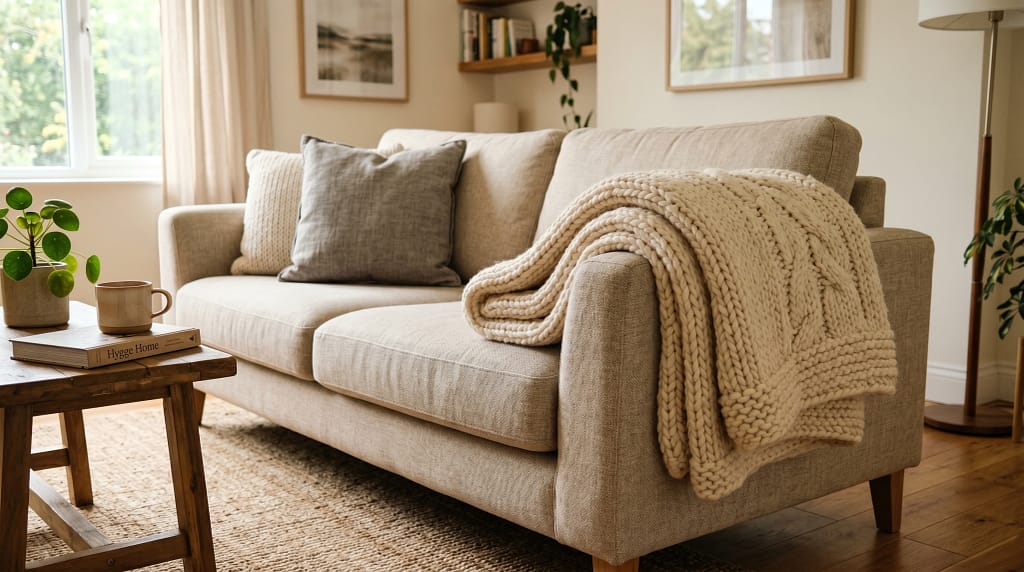
One throw rule to live by: if you’re using a patterned or textured throw, keep your cushions simpler. If your cushions are doing more visual work (mixed textures, one bold accent), keep the throw plain. Don’t let both elements compete for attention at once.
Rule 4: Let the Rug Do the Anchoring
A sofa on its own, especially a pale neutral one, can feel like it’s floating in the room – disconnected from the floor, slightly unfinished. A well-sized rug anchors the entire space and pulls everything together visually.
The most common rug mistake with neutral sofas is going too small. As a rule, the front legs of your sofa (and ideally all four) should sit on the rug – a rug that only the coffee table touches makes the whole arrangement look under-furnished.
For texture and warmth specifically, pair your neutral sofa with natural fiber rugs. Jute rugs, in particular, work exceptionally well with neutral sofas because their texture echoes the same “more depth without more color” principle that governs everything else on this list. Pair your sofa with jute rugs, linen cushions, and wooden elements, and the whole space suddenly feels alive rather than flat.
If your room runs cool (grey sofa, cool-toned walls), a warm-toned jute or wool rug introduces exactly the kind of grounding warmth a neutral palette needs. If your room already runs warm, a flatweave rug in a soft geometric pattern adds visual interest without competing.
Rule 5: One Bold Thing, Not Five Small Things
This is the rule most “neutral but not boring” guides get backwards. The instinct is to add five small colorful things – a colorful cushion here, a patterned throw there, a bright vase, a quirky side table. The result is usually more chaotic than the boring beige room you started with.
The better approach: one bold thing, done properly, and everything else stays calm around it.
Accent pieces can serve as a singular focal point in a neutral room – artwork, a single statement chair, or one striking decorative object that stands out clearly against the soft palette. Choosing one bold accent elevates the overall design without overwhelming it the way several competing accents would.
The best “one bold thing” options for a neutral sofa:
- A large abstract artwork above the sofa – a colorful or graphic piece hung directly above the sofa instantly becomes the room’s focal point and gives the eye somewhere to land. This single move does more for a “boring” neutral room than any number of small accessories
- A single statement accent chair – if your room has space for a second seat, an accent chair in a bold color or pattern works as a counterpoint to the calm sofa, without overwhelming the whole space
- One sculptural floor lamp or vase – for renters or smaller budgets, a single striking object on a side table can do the same visual job as a bold chair

The discipline here is the hard part. Pick one. Resist the urge to also add a patterned rug, a bright cushion, and a quirky lamp in the same room. Neutral rooms work because of restraint – break that restraint in more than one place and the calm, intentional feeling disappears.
Rule 6: Match Your Undertone Before You Buy Anything
Not all neutral sofas behave the same way, and this is the step most people skip before they start accessorizing – which is exactly why the styling sometimes feels like it’s not quite working even when they’ve followed every rule above.
Warm-toned neutrals (cream, beige, warm taupe, oatmeal) pair beautifully with earthy accent colors – terracotta, sage green, soft rust, warm browns. These colors share the same warm undertone as the sofa, so even a bold accent color feels cohesive rather than clashing.
Cool-toned neutrals (grey, dove, cool stone) need warmth introduced deliberately through accessories – rust, mustard, deep green, or warm wood tones. Without this, a cool grey sofa can tip into feeling cold or clinical rather than calm.
If you’d rather keep things fully tonal, layering different shades of the same neutral palette – a stone cushion, an oatmeal throw, a cream rug – can feel just as elevated as introducing bold contrast color, as long as the texture rule (Rule 1) is still doing its job underneath.
A quick way to check your sofa’s undertone: look at it in natural daylight next to a pure white sheet of paper. If it leans yellow or pink, it’s warm. If it leans blue or green, it’s cool. This single check will save you from buying accent pieces that quietly clash for months before you figure out why the room never feels finished.
Rule 7: Bring the Outside In
Nature is the ultimate designer, and it’s one of the easiest, cheapest fixes available for a flat neutral room. Leafy prints, nature-inspired patterns, and – most simply – actual plants provide an instant connection to the outdoors that a fully manufactured, fully neutral room is otherwise missing.
A large leafy plant in the corner near the sofa does three things at once: it adds a genuine third color (green) without disrupting the neutral palette, it adds height and shape that flat accessories can’t, and it adds movement and life to a room that can otherwise feel static.
Low-maintenance options that work well near a neutral sofa: a snake plant or ZZ plant for low light, a fiddle leaf fig or rubber plant for a larger statement, or a trailing pothos on a high shelf for softness without floor space commitment.
The 15-Minute Styling Routine
If you genuinely want the lazy version – the one that takes the least time and money – here’s the order of operations:
- Wash and fluff your existing cushions, then rearrange them asymmetrically (free, 2 minutes)
- Add one chunky-knit or faux fur throw, draped over one arm (one purchase, 1 minute to style)
- Check your rug size – extend it if the sofa’s front legs aren’t on it (may require a rug swap, but transforms the whole room)
- Pick one bold thing – art above the sofa is the highest-impact, lowest-effort option (one purchase, 10 minutes to hang)
- Add one plant near the sofa (one purchase, 2 minutes to place)
That’s it. No new sofa, no repaint, no full room overhaul – and the room stops reading as unfinished.
What NOT to Do to a Neutral Sofa
A few common mistakes undo all the good styling work above:
Matching everything too closely. If your cushions, throw, and rug are all the exact same shade of beige, the room reads as flat regardless of texture. You need tonal variation, not just textural variation.
Skipping the rug. A neutral sofa with no rug, or a too-small rug, looks unanchored no matter how well the cushions are styled.
Too many small accents. As covered in Rule 5 – five small colorful objects create visual noise, not warmth. Pick one.
Forgetting the room is allowed to change seasonally. A neutral sofa is actually the ideal base for seasonal styling – swap a chunky knit throw and dark cushions in winter for a linen throw and lighter tones in summer. Treat the cushions and throws as the changeable layer, and the sofa as the constant.
Choosing a trendy accent color you won’t love in two years. A sofa is one of the longest-standing investments in a room – it will likely outlast the paint color, the rug, and several rounds of redecorating. Accent pieces are cheap and easy to swap; let those carry the trend risk, not the sofa itself.
Is a Neutral Sofa Still a Good Investment in 2026?
Yes – arguably more than ever. While bold, characterful sofas are having a real moment in 2026 (patterned upholstery and deep jewel tones are both trending hard right now), interior designers are consistent on one point: choosing a sofa based purely on what’s trending is exactly the kind of thinking that leads to expensive regret a few years down the line.
A neutral sofa remains the safer long-term structural choice precisely because it gives you permission to chase trends in the cheap, swappable layer – cushions, throws, art, rugs – without ever needing to replace the most expensive piece of furniture in the room.
The one undertone shift worth knowing about for 2026 specifically: cool, saturated grey and navy-leaning neutrals are losing favor, while warmer neutrals – mocha, cognac, caramel, warm taupe – are gaining ground. If you’re choosing a new neutral sofa this year rather than restyling an existing one, leaning warm will keep the piece feeling current for longer.
For more on how leg style and proportion affect the same “does this look intentional or accidental” question, see our breakdown of sofa leg styles and how they change a room – it’s the other detail people overlook on a neutral sofa.
Final Thoughts
A neutral sofa was never the problem. The room around it just needed one more layer than it had – texture, an anchoring rug, one bold focal point, and a little asymmetry where everything had been sitting too perfectly straight.
None of this requires buying a new sofa, hiring a designer, or spending a weekend repainting. It requires noticing where the room is flat, and fixing exactly that – nothing more, nothing less. That’s the whole appeal of the neutral sofa in the first place: it does the hard, expensive, long-term job quietly, and lets you do the fun, cheap, easily-changed styling on top.
Loved this guide? Pin it to your living room board for the next time your neutral sofa needs a refresh.
Related posts you might like: