

You’ve spent weeks choosing the right sofa fabric, the right color, the right depth of cushion. But there’s one detail most people treat as an afterthought that quietly determines whether the whole room works: the legs.
Sofa legs are the “shoes” that complete your furniture’s outfit. Change them and you change everything – the visual weight of the sofa, how open or grounded the room feels, whether the space reads as contemporary or traditional, and even how large the room appears. In 2026, modern sofa leg designs are no longer just functional supports: they are one of the fastest and most affordable ways to transform a room’s entire personality.
This guide covers every major sofa leg style, what each one does to a room, which interior aesthetics they belong to, and exactly how to choose the right one for your specific space and sofa.
Table of Contents
- Why Sofa Legs Matter More Than You Think
- Tapered Legs — The Mid-Century Classic
- Hairpin Legs — Industrial Minimalism
- Block Legs — Grounded and Contemporary
- Sled Base — The Architectural Statement
- Turned Legs — Traditional Elegance
- Cabriole and Cabriolet Legs — Antique Drama
- Splayed Legs — Retro and Stable
- Hidden Base / Legless — The Minimalist Option
- Bun Feet — Cosy and Grounded
- Wood vs Metal Sofa Legs — Which to Choose
- Leg Height: What It Does to the Room
- How to Choose the Right Sofa Leg Style for Your Room
- Can You Swap Sofa Legs?
- Final Thoughts
Why Sofa Legs Matter More Than You Think
Furniture legs set the posture of a piece. Slim, tapered legs can make a sofa feel lighter on the floor. Bold block legs give a sofa quiet authority. Curved legs can soften a formal living room and make traditional furniture feel graceful rather than stiff. People notice the effect even when they don’t know the vocabulary yet.
Leg style also shapes practical outcomes: how easy the room is to clean, how the sofa affects perceived ceiling height, how well the furniture ages over years of daily use. A sofa that looks beautiful from the top but unresolved at the bottom will never feel fully satisfying.
The three things sofa legs control:
- Visual weight — High legs make a sofa appear to float; low or hidden legs make it appear heavy and grounded
- Room scale — Exposed floor space under raised legs makes a room feel larger; block or legless bases absorb floor space and make a room feel more intimate
- Aesthetic identity — Tapered legs say mid-century; turned legs say traditional; hairpin legs say industrial; sled bases say contemporary. The legs position the sofa in a design era as clearly as any other detail
With that foundation in place, here are the major sofa leg styles and exactly what each one does.
Tapered Legs — The Mid-Century Classic
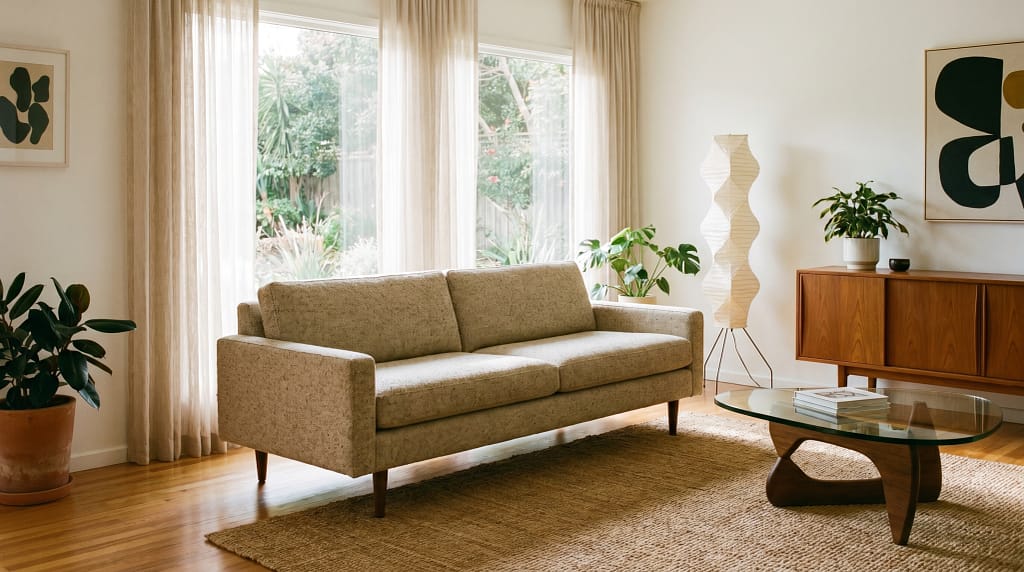
Tapered legs – wider at the top, narrowing cleanly toward the bottom – are the signature of mid-century modern furniture. The tapered leg is the pinnacle of mid-century modernism: if the style defined a generation, the tapered leg defined the style. Its origins actually trace back to ancient times, but it found its cultural moment in the postwar design optimism of the 1940s and 50s, becoming shorthand for a fresh, forward-looking aesthetic.
In 2026, tapered wooden legs in oak or walnut are still one of the dominant sofa leg choices – and for good reason. They balance warmth (wood grain and tone) with clean modern geometry (the precise taper). They look effortless in Scandinavian, Japandi, mid-century, and transitional interiors without trying too hard.
What tapered legs do to a room:
- Create a light, airy feel by revealing more floor underneath
- Make a room appear larger – particularly effective in smaller spaces
- Add visual warmth through natural wood tones
- Work with almost every sofa silhouette, from boxy three-seaters to curved accent sofas
Best for: Mid-century modern, Scandinavian, Japandi, transitional interiors Materials: Walnut and oak are the premium choices; beech is the budget-friendly alternative Avoid with: Very ornate, maximalist, or antique-heavy rooms where the clean taper can look too casual
Pro tip: If your room already has strong architectural lines – large windows, modern lighting, clean walls – tapered or straight legs keep the look cohesive without competing.
For more on building a room around a statement sofa with tapered legs, see our guide on how to style a curved sofa – curved sofas on tapered walnut legs are one of the most requested combinations in 2026 interiors.
Hairpin Legs — Industrial Minimalism
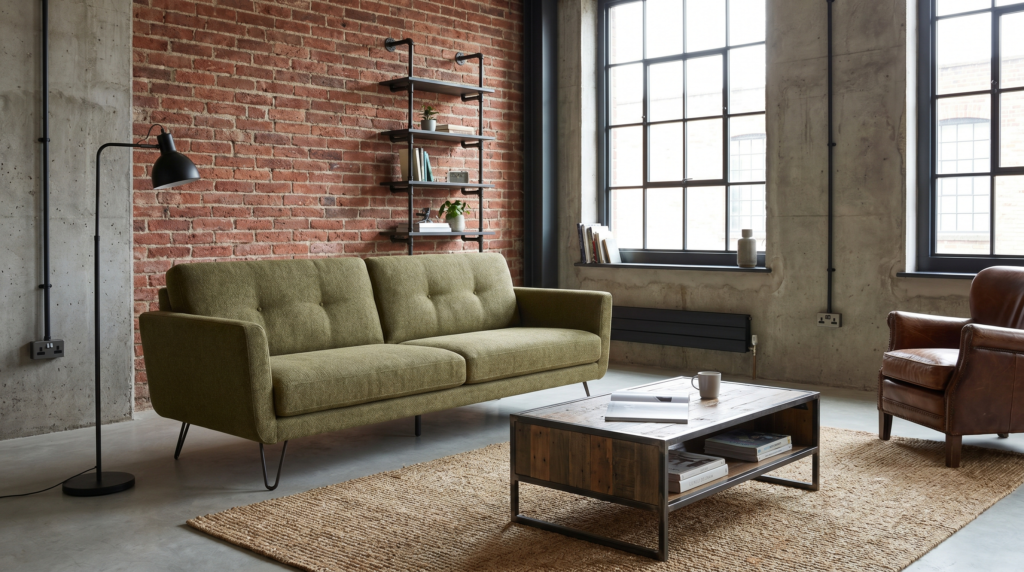
Hairpin legs are made from thin metal rods bent into a U-shape, creating a sleek, open look that makes the sofa appear lighter and more airy. The design was invented in 1941 by Henry P. Glass and became closely tied to the stripped-down, factory-like aesthetic of mid-century modern furniture – but their clean, unobtrusive quality means they now cross over into contemporary and industrial interiors just as naturally.
Hairpin legs are particularly effective in small rooms and apartments. They expose the maximum amount of floor underneath the sofa, creating the impression of significantly more space than is actually there. They are frequently cited as one of the best sofa legs for small living rooms because of precisely this quality.
What hairpin legs do to a room:
- Make the sofa look like it’s floating – maximum visual lightness
- Expose the most floor space of any leg style, making rooms feel larger
- Add an industrial, gallery-like edge to the space
- Work particularly well with matte black finishes against pale upholstery for high contrast
Best for: Industrial, contemporary, eclectic, loft-style interiors Materials: Steel is standard – available in matte black, brushed steel, copper, and brass finishes Avoid with: Traditional, farmhouse, or Grandmillennial interiors where the industrial metal reads as jarring
Finish pairing: If your room has brass accents (light fixtures, mirror frames, cabinet hardware), a brass or warm gold hairpin leg creates a cohesive metallic language. Matte black hairpin legs work beautifully against cream or ivory velvet upholstery.
Block Legs — Grounded and Contemporary
Block legs are thick squares or rectangles that sit close to the ground, offering maximum stability and a deliberate sense of weight. They give a heavy, grounded look that works particularly well with large family sofas and modular configurations – pieces that need to feel permanent and anchored rather than light and airy.
Unlike tapered or hairpin legs, block legs don’t try to minimize the sofa’s presence – they lean into it. The sofa becomes a substantial, architectural piece rather than something that appears to float in the room.
What block legs do to a room:
- Anchor the sofa as a heavy, deliberate focal point
- Create a sense of permanence and solidity
- Work beautifully in rooms where stability is prioritized over airiness
- Suit oversized, deep-cushioned sofas that already dominate the room
Best for: Contemporary, transitional, Japandi, and family-focused living rooms Materials: Oak, walnut, and matte-finished hardwoods are most common; some contemporary versions use powder-coated metal Avoid with: Small rooms where the reduced floor visibility will make the space feel even more cramped
Practical note: Block legs mean less clearance underneath – vacuuming is harder, but there’s also less space for dust to collect. Taller block legs (4–5 inches) thread the needle between stability and some floor visibility.
Sled Base — The Architectural Statement
The sled base doesn’t use separate legs at all – instead, it uses a continuous metal or wood frame that creates a rectangular or angled base running the full length of the sofa. It’s a design borrowed from mid-century Scandinavian furniture and refined by contemporary minimalist designers.
Tapered wooden legs and matte black metal sled bases are currently dominating modern furniture trends in 2026 – together, they represent the two directions contemporary sofa design is moving: one warm and organic (tapered wood), the other cool and architectural (sled base).
What a sled base does to a room:
- Creates a strong, sculptural silhouette – the base becomes a design feature in itself
- Gives the sofa a low, horizontal emphasis that makes ceilings feel higher
- Works brilliantly in open-plan spaces where the sofa is visible from multiple angles – the base looks just as intentional from the side as from the front
- Suits rooms with a lot of architectural detail or minimalist discipline
Best for: Minimalist, Scandi, contemporary, and loft-style interiors Materials: Matte black powder-coated steel is most common; natural oak sled bases are increasingly popular for Japandi-adjacent spaces Avoid with: Traditional or ornate interiors where the industrial geometry reads as out of place
The advantage of metal in sled bases lies in its strength-to-weight ratio, allowing for slender forms without compromising structural integrity – the sled can span the full length of a three-seater without needing additional support mid-frame.
Turned Legs — Traditional Elegance
Turned legs are crafted on a lathe, producing decorative curves, spirals, and trumpet shapes that express ornamentation and historical reference. They trace back to 17th century European furniture-making, with spiral legs becoming popular in England between 1660 and 1703 and turning up consistently through the Victorian era and beyond.
In 2026, turned legs are seeing renewed interest through what designers are calling the “Grandmillennial” trend – a knowing, affectionate return to traditional furniture forms that feel cosy and character-rich without being dusty or dated.
What turned legs do to a room:
- Add immediate historical character and warmth
- Signal craftsmanship and traditional design lineage
- Make a sofa feel like it belongs in a curated, layered interior rather than a showroom
- Work beautifully with tufted upholstery, rich velvet, and traditional fabric patterns
Best for: Traditional, Grandmillennial, country, farmhouse, and eclectic interiors Materials: Dark walnut, mahogany, and painted wood (white or black) are all used Avoid with: Minimalist, Scandi, or industrial interiors where ornate detail creates visual noise
If your room has a lot of clean lines, modern lighting, or a simple sectional sofa, turned legs will likely look out of place. They belong in rooms that embrace texture, layering, and character.
Cabriole and Cabriolet Legs — Antique Drama
The cabriole leg is the S-curve of the furniture world: it bows outward at the knee, then curves inward and ends in a decorative foot (often a claw-and-ball or pad foot). It’s rooted in Queen Anne and Chippendale furniture from the early-to-mid 18th century and carries an unmistakable air of period refinement.
In 2026 interiors, cabriole legs appear most often on statement accent sofas and loveseat-scale pieces where the leg becomes part of the furniture’s sculptural identity. On a full three-seater, the drama can tip into overpowering – but on a smaller curved sofa or settee, a cabriole leg elevates the piece into something genuinely distinctive.
What cabriole legs do to a room:
- Introduce period drama and immediate visual interest
- Give a modern velvet or tufted sofa a classy, antique-influenced edge
- Work as a conversation piece in their own right
- Complement rich, jewel-tone upholstery – deep plum velvet on a cabriole sofa is one of the most classically opulent combinations in interior design
Best for: Traditional, Art Deco-influenced, maximalist, and eclectic interiors Materials: Dark woods – walnut, mahogany, and ebonized finishes – are most common Avoid with: Minimalist, Scandi, or industrial rooms where they read as dramatically mismatched
Splayed Legs — Retro and Stable
Splayed legs angle outward from the base, giving the sofa a slightly dynamic, confident stance. They are closely associated with 1950s and 60s retro design but have a contemporary relevance in 2026 as part of the broader interest in vintage-influenced furniture forms.
Splayed legs are very stable – the outward angle distributes the sofa’s weight more broadly than straight vertical legs – and they have a retro-cool look that makes them feel like a designer made an intentional choice rather than defaulting to the standard.
What splayed legs do to a room:
- Add a retro, considered quality to the sofa’s stance
- Create the impression of a wider, more planted piece of furniture
- Introduce a subtle sense of movement compared to straight vertical legs
- Pair naturally with curvier, more organic sofa silhouettes
Best for: Retro, mid-century, eclectic, and Grandmillennial interiors Best pairing: A splayed wooden leg on a curved, velvet sofa in a jewel tone is a combination that appears in high-end interior design repeatedly – the outward angle of the leg echoes the outward curve of the sofa arm.
Hidden Base / Legless — The Minimalist Option
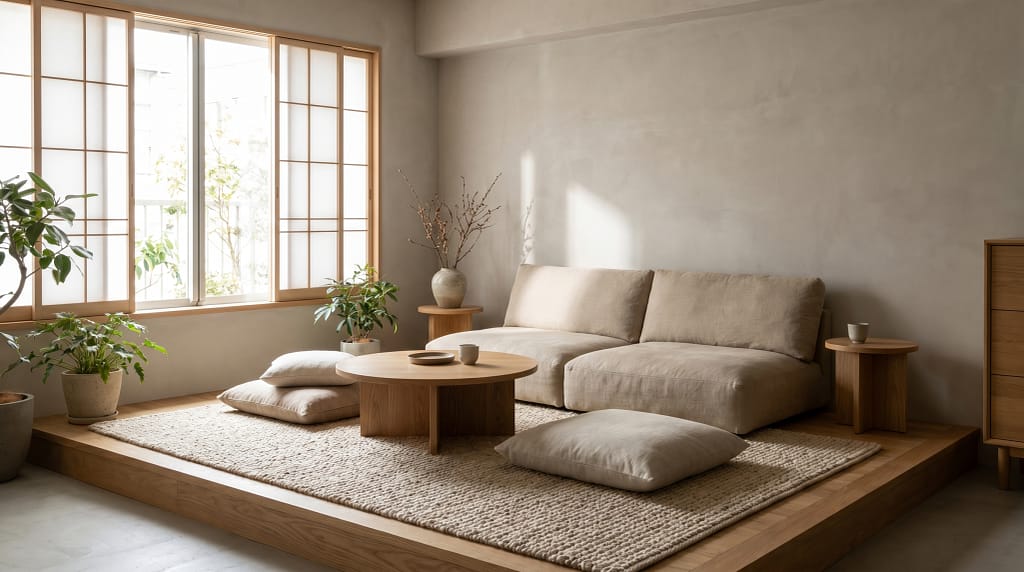
The legless or hidden base sofa sits directly on the floor or on a low, recessed plinth that makes it appear to float without visible support. It’s a defining feature of minimalist and modular sofa design – and in 2026, it’s being pushed further by the influence of Japandi interiors and the ongoing appetite for low-profile, floor-level living.
The absence of legs and the continuity of the padding accentuate the sofa’s monolithic effect, making it the absolute protagonist of the space. A legless sofa doesn’t share visual attention with other furniture – it commands the room.
What a legless base does to a room:
- Creates a dramatic, architectural focal point
- Makes the sofa look like a sculptural installation rather than just seating
- Lowers the visual center of gravity, making ceilings feel dramatically higher
- Works particularly well in rooms with polished concrete, herringbone timber, or large-format tile floors where the uninterrupted floor plane is part of the aesthetic
Best for: Minimalist, Japandi, contemporary, and architectural interiors Avoid with: Rooms with patterned or busy flooring, or homes with pets/children where cleaning underneath matters
Practical consideration: Legless sofas have no clearance underneath – cleaning is either impossible or requires moving the sofa. If this matters to you, opt for a low block leg (2–3 inches) instead of true floor contact.
Bun Feet — Cosy and Grounded
Bun feet look exactly as described: short, rounded forms that flatten slightly at the bottom, resembling a small bread roll. The style became popular in the early 1600s in William and Mary furniture and has persisted as the classic base for traditional upholstered sofas and armchairs.
They’re the leg equivalent of a comfort choice – warm, approachable, unpretentious. In 2026, bun feet are appearing on the sofas associated with the “Grandmillennial” and maximalist interior trends, where character and warmth take precedence over sleek minimalism.
What bun feet do to a room:
- Add immediate warmth and approachability – the antithesis of industrial minimalism
- Suit sofas where the upholstery is the star and the legs shouldn’t distract
- Work perfectly with skirted sofas where only a small portion of the leg shows at the base
- Pair beautifully with traditional fabrics: linen, chintz, traditional velvet, and textured tweed
Best for: Traditional, Grandmillennial, country house, and farmhouse interiors
Wood vs Metal Sofa Legs — Which to Choose
The material of the leg is often as important as its shape. Wood and metal create fundamentally different impressions:
Wooden sofa legs offer warmth, authenticity, and tactile quality. They suit interiors that prioritize natural materials and organic textures. Hardwood varieties (oak, walnut, beech) ensure longevity, and the finish – whether natural, stained, or painted – gives you control over how the leg integrates with the room’s palette. The drawback: wood can show wear in high-traffic homes if not properly sealed, and pets that like to chew furniture will damage wood legs faster than metal.
Metal sofa legs offer sleekness, precision, and durability. Their strength-to-weight ratio allows for much slimmer forms without structural compromise – a hairpin leg can be pencil-thin while supporting a full three-seater. Metal legs also resist humidity and temperature fluctuations better than untreated wood, making them better for coastal or humid climates. Finishing options add personality: brushed steel for minimalist interiors, matte black powder coating for industrial contrast, brass or bronze for contemporary Art Deco.
The 2026 direction: Tapered wooden legs and matte black metal sled bases are the two dominant leg choices in modern furniture right now – warm organic versus cool architectural. If you’re unsure, those two represent the safest bets for longevity of style.
Leg Height: What It Does to the Room
Leg height is one of the most underestimated variables in sofa selection. Standard sofa legs run between 4 and 6 inches. Here’s what changing that height does:
Higher legs (6–8 inches): Create a formal, elevated feel. More floor is visible, making the room feel more open. Easier to clean underneath. Better suited to rooms with beautiful flooring you want to show off. Creates a higher seating position, which suits people who find low sofas hard to get in and out of.
Standard legs (4–6 inches): The versatile middle ground. Works in most rooms without committing to either a very grounded or very elevated look.
Lower legs (2–3 inches): Creates a casual, lounging atmosphere. The sofa feels closer to the floor, which can feel cozy and informal. Makes a room feel more intimate but can make ceilings feel lower. Harder to clean underneath.
Shorter sofa legs create a cozy atmosphere suitable for compact living spaces, while longer legs give an airy feel beneficial for larger rooms. Even a small difference in leg height – two inches – can meaningfully change how a room reads.
A practical note for small living rooms: see our best sofa for small living room guide – leg height is one of the first specifications we look at for compact spaces.
How to Choose the Right Sofa Leg Style for Your Room
With all the options above, a simple framework makes the decision manageable:
Step 1 — Match the aesthetic. What is the dominant design language of your room? Minimalist → sled base or hairpin. Traditional → turned or bun feet. Mid-century → tapered walnut. Industrial → hairpin or matte black sled. Eclectic → splayed or cabriole. If your room has strong architectural lines – large windows, modern lighting – tapered or straight legs keep things cohesive. If your home leans classic, a turned or cabriole leg adds shape and warmth.
Step 2 — Assess your room size. Small room → always prioritize exposed floor space. Tapered, hairpin, or splayed legs show the most floor and make a room feel largest. Legless or block legs absorb floor space and suit larger rooms where intimacy isn’t a concern.
Step 3 — Match your metals. If your room has brass light fixtures, coffee table frames, or cabinet hardware, mirror that finish in the sofa leg metal. Mixing brass and chrome in the same room creates visual noise.
Step 4 — Consider the sofa silhouette. Curved sofas work beautifully with tapered or splayed legs – the outward angle of splayed legs echoes the curve. Boxy, modular sofas suit block or sled bases. Tufted or rolled-arm traditional sofas suit turned legs or bun feet.
Step 5 — Think about practicality. Pets that chew → choose metal over wood. Young children → prioritize stable block or sled bases over narrow hairpin legs. High-traffic home → sealed hardwood or powder-coated metal over raw or lightly finished wood.
For a full breakdown of sofa proportions that work in different room sizes, our sofa size guide covers how leg height interacts with seat depth and overall sofa height.
Can You Swap Sofa Legs?
Yes — and it’s one of the most cost-effective room updates available. Most modern sofas use a standard M8 bolt fixing, making it straightforward to swap old legs for a completely new style. The process typically takes under 30 minutes with no specialist tools.
Swapping sofa legs is worth doing when:
- You’ve changed the room’s aesthetic since buying the sofa
- The original legs feel dated but the sofa frame and upholstery are in good condition
- You want to raise or lower the sofa for ergonomic or visual reasons
- You’ve updated metal finishes elsewhere in the room (new light fixtures, new hardware) and the original leg finish no longer coordinates
Check the leg attachment system before purchasing replacement legs – most use the M8 threaded bolt, but some manufacturers use proprietary fittings. The Hairpin Leg Co. and similar hardware specialists stock replacement legs in most major styles and finishes, available by the set of four.
Final Thoughts
Sofa leg styles are the detail most people overlook and the one that makes the most quietly powerful difference to a room. They determine whether a sofa looks grounded or floating, traditional or contemporary, intimate or open – and they do it in a way that’s almost invisible when they’re right, and immediately noticeable when they’re wrong.
The good news is that leg style is also one of the most correctable details in furniture design. You can swap them out, update the finish, raise or lower the height – all without replacing the sofa itself. In 2026, mixing materials and making sure every element from cushions to floor fits your style is the direction interior design is moving. Sofa legs are the most affordable place to express that intention.
Whether you go for the clean warmth of tapered walnut, the sculptural minimalism of a sled base, or the historic drama of a turned leg, the key principle is the same: choose a style that belongs to the room’s design language, and let the legs do the quiet, essential work of pulling the whole space together.
Enjoyed this guide? Pin it to your living room board and share it with anyone currently furniture shopping.
Related posts you might like:




[…] guidance on which sofa leg styles work best with mid-century furniture, see our sofa leg styles guide – tapered walnut is covered in full detail with pairing […]