


Table of Contents
- Introduction
- How to Choose the Right Sofa for a Small Living Room
- Top Sofa Types for Small Spaces
- Best Sofas for Small Living Rooms (Round-Up)
- Sofa Layout Ideas & Room Planning
- Storage Solutions for Small Living Rooms
- Fabric & Material Guide
- Budget-Friendly Options & Where to Buy
- Pros & Cons: Brand vs Local / IKEA Alternatives
- FAQ Section
- Conclusion
1. Introduction
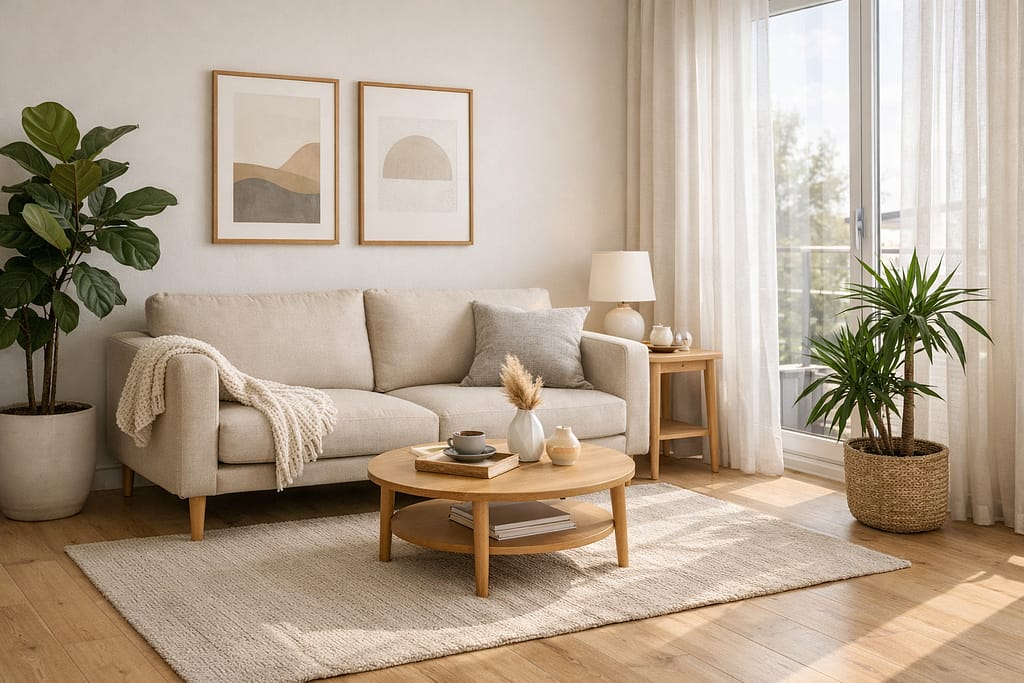
Let’s be real, finding the best sofa for a small living room can feel like solving a Rubik’s Cube blindfolded. You want something stylish, comfortable, and functional, but you’re working with the square footage of a walk-in closet. Sound familiar?
Here’s the good news: small living rooms don’t mean you have to sacrifice comfort or style. With the right sofa choice, you can actually make your space feel bigger, brighter, and way more inviting. Whether you’re furnishing a studio apartment, a cozy city condo, or just trying to maximize every inch of your home, this guide has you covered.
We’ll walk through everything from measuring your space correctly (yes, there’s a right way!) to choosing between sectionals, loveseats, and those genius sofa beds that basically do double duty. Plus, we’re throwing in real product recommendations, layout hacks, and budget-friendly tips that actually work.
Ready to find your perfect small-space sofa? Let’s dive in.
2. How to Choose the Right Sofa for a Small Living Room
Before you fall in love with that gorgeous velvet sectional online, let’s talk strategy. Choosing a sofa for a small space isn’t just about picking the cutest one, it’s about making smart decisions that’ll save you from buyer’s remorse (and a sore back from squeezing past furniture).
2.1. Size & Dimensions (Inches/Feet)
Measure twice, buy once. I can’t stress this enough.
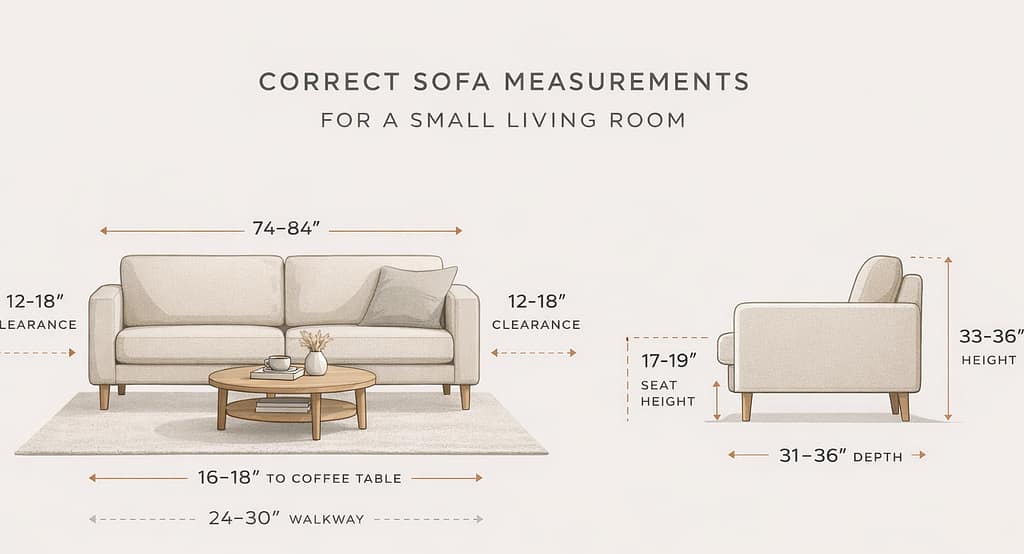
For small living rooms (think 10×12 feet or smaller), you’re generally looking at sofas between 60-80 inches wide. Here’s a quick breakdown:
- Loveseats: 52-64 inches wide (perfect for tiny spaces)
- Apartment sofas: 68-80 inches wide (the sweet spot for most small rooms)
- Compact sectionals: 75-90 inches total (if you’re strategic about placement)
Pro tip: Don’t just measure the sofa, measure your doorways, hallways, and any tight corners it needs to navigate. A sofa that fits your room but not through your door is a very expensive mistake.
Also, consider depth. Standard sofas are 36-40 inches deep, but in a small room, you might want something closer to 32-35 inches to maintain walkway space.
2.2. Shape & Layout Considerations
The shape of your sofa can make or break your room flow.
Best shapes for small spaces:
- Straight sofas: Classic and space-efficient, these sit flush against walls
- L-shaped sectionals: Great for defining zones in studio apartments
- Round/curved sofas: These soften sharp corners and improve traffic flow (though harder to find)
- Armless sofas: Shave off 10-12 inches of width by ditching bulky arms
Avoid: Oversized recliners, bulky rolled arms, and anything with “grand” or “oversized” in the description.
2.3. Fabric & Color Choices
Here’s where things get fun, but also strategic.
Light colors make rooms feel larger. It’s not just design folklore; light grays, beiges, soft blues, and whites genuinely create the illusion of more space by reflecting light. That said, if you have kids or pets, you might want to think twice about that pristine white linen.
Best fabrics for small spaces:
- Performance fabrics: Stain-resistant and durable (hello, Crypton and Sunbrella)
- Microfiber: Budget-friendly and surprisingly tough
- Leather: Ages beautifully and is easy to wipe clean
- Textured weaves: Add depth without visual weight
Skip super dark colors unless your room gets tons of natural light, they can make small spaces feel cave-like.
2.4. Budget vs Premium Options
Let’s talk money.
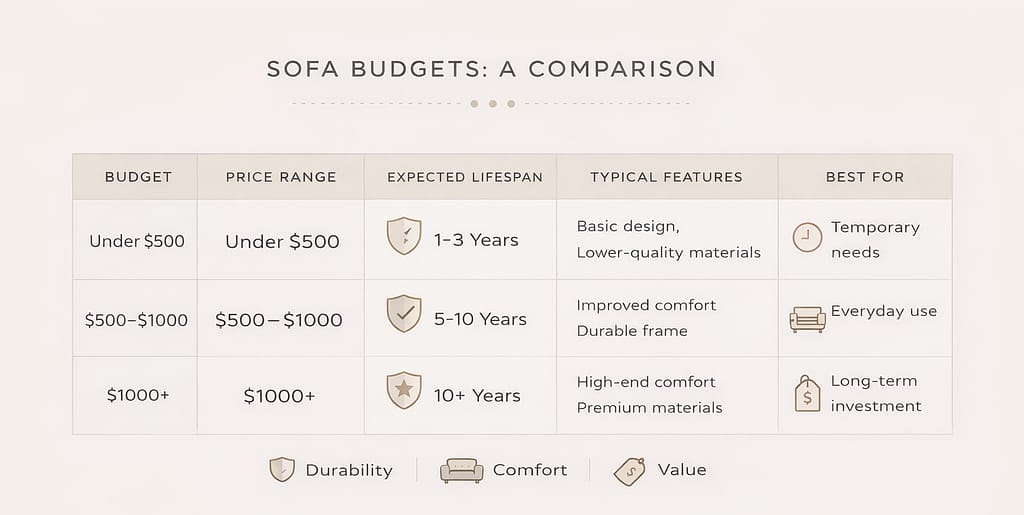
You can absolutely find a decent sofa for under $500, but expect to replace it in 3-5 years. Mid-range options ($500-$1500) typically offer better construction and fabrics that’ll last 7-10 years. Premium sofas ($1500+) are investments; we’re talking hardwood frames, eight-way hand-tied springs, and fabrics that laugh in the face of everyday wear.
My take? For a small living room where your sofa gets heavy use, aim for the $700-$1200 range. You get quality without breaking the bank.
3. Top Sofa Types for Small Spaces
Not all sofas are created equal, especially when you’re dealing with limited square footage. Let’s break down the MVPs of small-space seating.
3.1. Sectionals
Wait, sectionals in a small room? Hear me out.
Compact sectionals (around 75-85 inches total) can actually maximize seating without eating up floor space. The key is choosing one with a chaise on one end rather than a full L-shape.
When sectionals work:
- You need to define separate zones (living + dining in a studio)
- Your room is narrow and long
- You want maximum seating for movie nights
When to skip them:
- Your room is smaller than 10×10 feet
- You rearrange furniture frequently
- You have awkward doorways or tight corners
3.2. Loveseats
The classic small-space solution, and for good reason.
Loveseats typically seat two people comfortably and max out around 60 inches wide.
They’re perfect for:
- Rooms under 150 square feet
- Pairing with accent chairs for flexible seating
- Creating a cozy, intimate vibe
Downside? Limited seating. If you regularly host friends, you’ll need to supplement with poufs, floor cushions, or extra chairs.
3.3. Sleeper Sofas / Futons
The ultimate multitaskers.
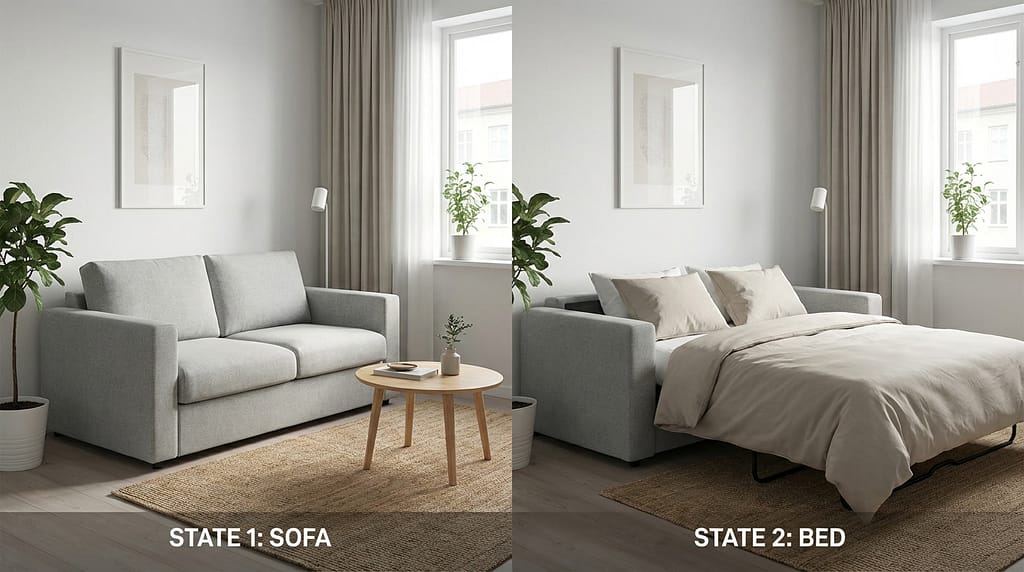
Modern sleeper sofas have come a long way from those torturous pull-out beds your grandma had. Today’s options feature memory foam mattresses and mechanisms that actually work smoothly.
Best for:
- Studio apartments
- Guest-friendly spaces
- Anyone who needs their living room to pull double duty
Watch out for: Added depth when the bed is extended. Make sure you have the floor space.
3.4. Modular Sofas (IKEA + Alternatives)
Modular sofas are like furniture Lego, you can reconfigure them as your needs change.
IKEA’s VALLENTUNA and SÖDERHAMN lines are budget-friendly modular options, while brands like Burrow, Lovesac, and Interior Define offer premium alternatives with better construction and fabrics.
Pros:
- Reconfigure for different layouts
- Easy to move (usually)
- Can expand as you get more space
Cons:
- Connection points can loosen over time
- Usually pricier than comparable non-modular sofas
3.5. Accent Chairs & Ottomans
Sometimes the best “sofa” for a small space isn’t a sofa at all.
Pairing a loveseat with two accent chairs gives you flexible seating that’s easy to rearrange. Throw in a storage ottoman as a coffee table, and you’ve got a setup that adapts to whatever you need.
This works great when:
- Your room has an awkward shape
- You want maximum flexibility
- You’re working with under $1000 total budget
4. Best Sofas for Small Living Rooms (Round-Up / Reviews)
Alright, let’s get to the good stuff, actual sofa recommendations that won’t swallow your room whole.
4.1. IKEA SÖDERHAMN
Price: Around $800-$1200 (depending on configuration)
Dimensions: 72″ W x 39″ D x 32″ H (3-seat version)
The SÖDERHAMN is IKEA’s answer to small-space living done right. It’s low-profile (great for making ceilings feel higher), modular (so you can start small and expand), and comes in washable covers, a game-changer for real life.
Pros:
- Affordable
- Replaceable, washable covers
- Low profile creates visual space
- Modular system
Cons:
- Firmer cushions (not for sink-in loungers)
- Assembly required (though easier than most IKEA pieces)
Best for: Renters, pet owners, anyone who likes to change things up.
4.2. Vitra Slow Sofa
Price: $4,000+
Dimensions: Various configurations, typically 71-87″ W
Okay, this is the splurge option, but if you’re all about design and have the budget, the Vitra Slow Sofa is stunning. It’s compact without feeling cramped, and the craftsmanship is next-level.
Pros:
- Gorgeous, timeless design
- Exceptional build quality
- Comfortable for all-day lounging
Cons:
- Seriously expensive
- Limited color/fabric options
- Might be too precious for everyday family use
Best for: Design enthusiasts with disposable income and a kid-free home.
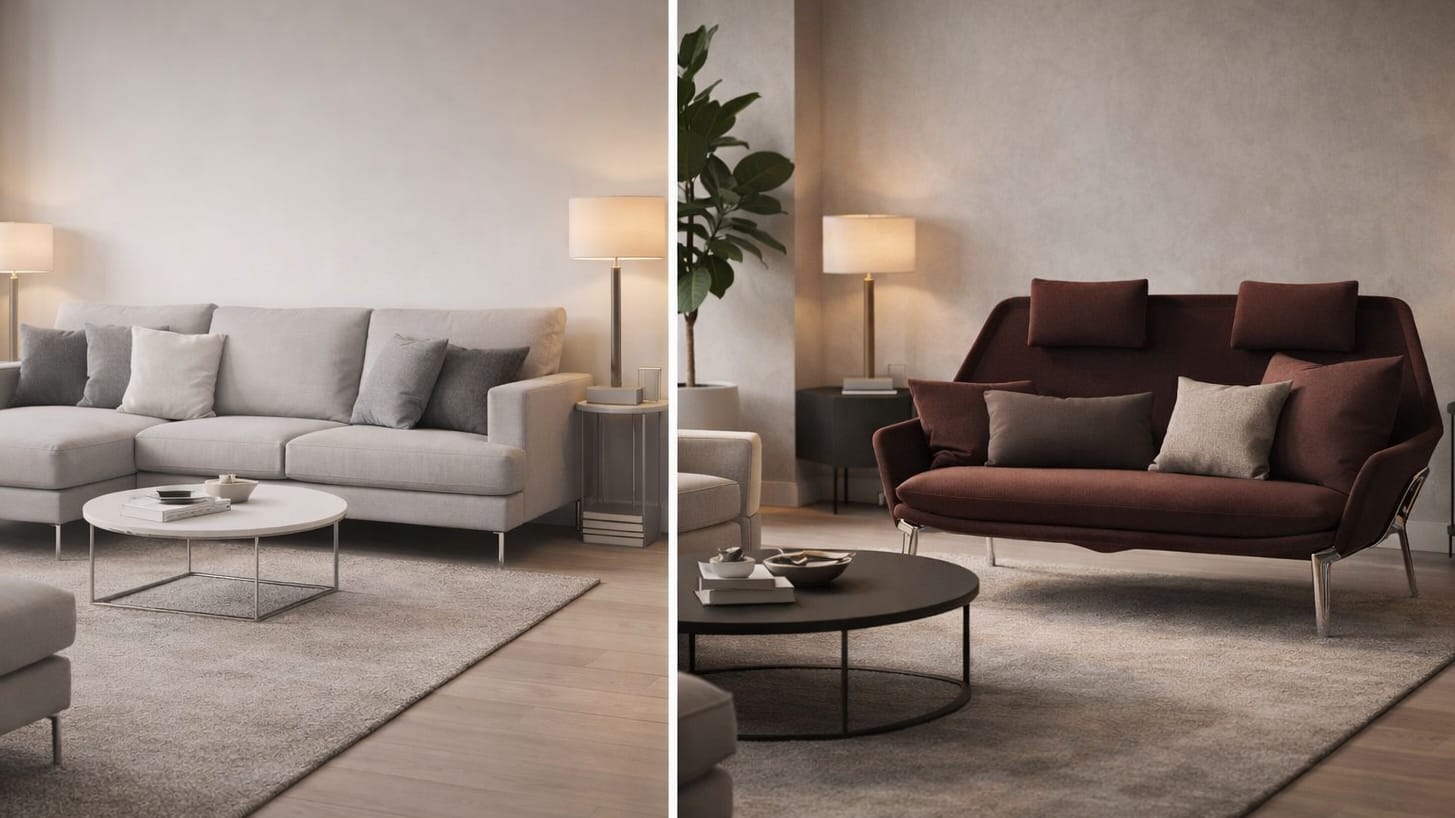
4.3. EVA Slideaway Bed
Price: $2,000-$2,800
Dimensions: 79″ W x 35″ D x 28″ H
This is a sleeper sofa that doesn’t look like a sleeper sofa. The EVA Slideaway has a pull-out trundle design rather than a fold-out mattress, which means less mechanism, less bulk, and way more style.
Pros:
- Sleek, modern design
- Actual comfortable sleeping surface
- Doesn’t sacrifice sofa comfort for bed function
Cons:
- Pricey for a sleeper
- Requires floor clearance to pull out
- Limited fabric selections
Best for: Studio dwellers who host overnight guests regularly.
4.4. Omhu! Teddy
Price: $600-$900
Dimensions: 68″ W x 35″ D x 31″ H
The Omhu! Teddy is basically a hug in sofa form. It’s compact, incredibly cozy with its boucle-style fabric, and won’t destroy your budget.
Pros:
- Super trendy aesthetic
- Comfortable for daily use
- Compact footprint
- Affordable
Cons:
- Textured fabric shows wear faster
- May not suit all design styles
- Lighter construction than premium options
Best for: Apartment dwellers who want Instagram-worthy style on a budget.
4.5. e9 Design Ethos
Price: $1,800-$2,500
Dimensions: Customizable, typically 72-78″ W
The Ethos line from e9 Design offers customization in a compact package. You pick the dimensions, fabrics, and even leg height to get exactly what your space needs.
Pros:
- Fully customizable
- Quality construction
- Mid-century modern aesthetic
- Made in the USA
Cons:
- 8-12 week lead time
- Can’t try before you buy
- Pricier than mass-market options
Best for: Anyone who wants a custom look without full custom pricing.
4.6. Bonus: Budget & Storage Options
Under $500 stars:
- Zinus Jackie Sofa: Around $400, perfect for tight budgets
- Novogratz Brittany Futon: $300-$400, converts to a bed
- Mainstays Apartment Sofa: Under $300 at Walmart, surprisingly decent
Storage heroes:
- FRIHETEN from IKEA: Sleeper sofa with storage under the chaise (~$600)
- Lifestyle Solutions Serta Sofa: Hidden storage under cushions (~$500)
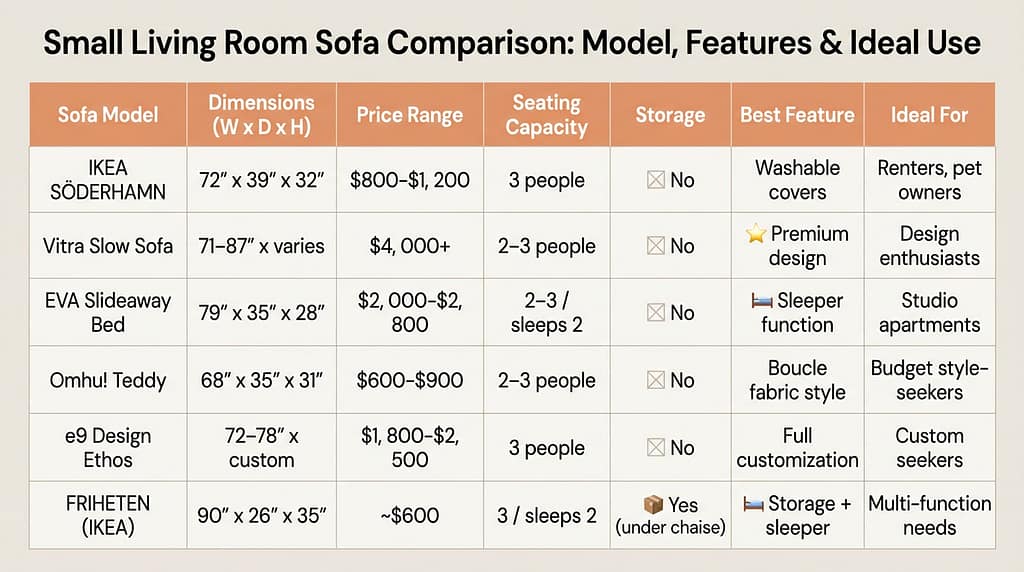
| Sofa Model | Dimensions (W x D x H) | Price Range | Seating Capacity | Storage | Best Feature | Ideal For |
| IKEA SÖDERHAMN | 72″ x 39″ x 32″ | $800-$1,200 | 3 people | No | Washable covers | Renters, pet owners |
| Vitra Slow Sofa | 71-87″ x varies | $4,000+ | 2-3 people | No | Premium design | Design enthusiasts |
| EVA Slideaway Bed | 79″ x 35″ x 28″ | $2,000-$2,800 | 2-3 / sleeps 2 | No | Sleeper function | Studio apartments |
| Omhu! Teddy | 68″ x 35″ x 31″ | $600-$900 | 2-3 people | No | Boucle fabric style | Budget style-seekers |
| e9 Design Ethos | 72-78″ x custom | $1,800-$2,500 | 3 people | No | Full customization | Custom seekers |
| FRIHETEN (IKEA) | 90″ x 26″ x 35″ | ~$600 | 3 / sleeps 2 | Yes (under chaise) | Storage + sleeper | Multi-function needs |
5. Sofa Layout Ideas & Room Planning
You’ve got the sofa, now where the heck does it go? Layout is where good intentions meet reality (and where most people get stuck).
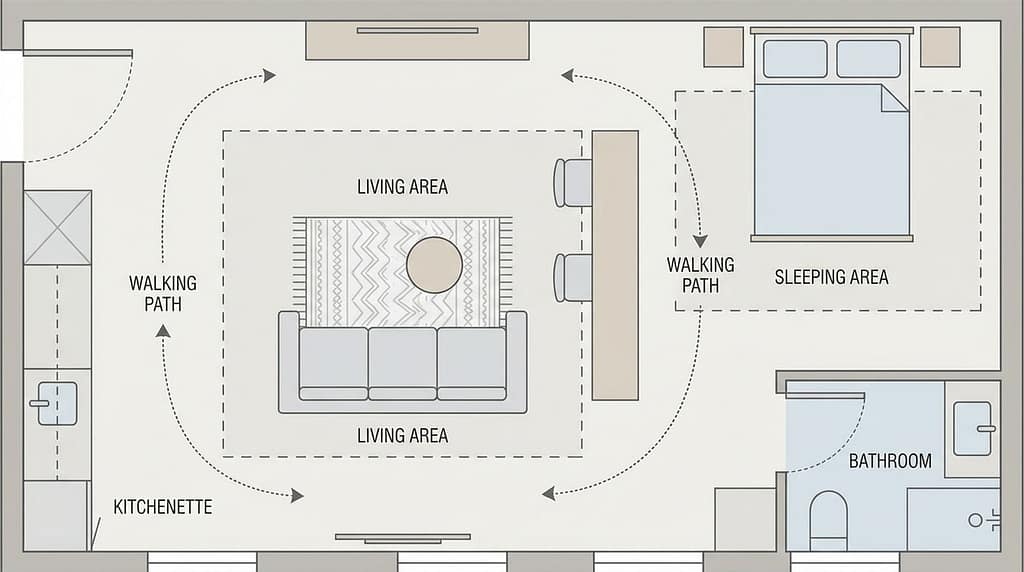
5.1. Studio Apartment Layouts
In a studio, your sofa needs to do more than provide seating, it needs to define your living zone.
The Float: Instead of pushing your sofa against a wall, float it in the middle of the room with the back facing your bed area. Add a console table behind it for storage, and boom, you’ve created a visual divider between sleeping and living spaces.
The Corner Wedge: Got a corner? A compact L-shaped sectional can maximize seating while keeping the center of your studio open for movement.
Pro tip: Use area rugs to define zones. A rug under your sofa creates a “living room” even when your bed is 10 feet away.
5.2. L-Shaped / Corner Layouts
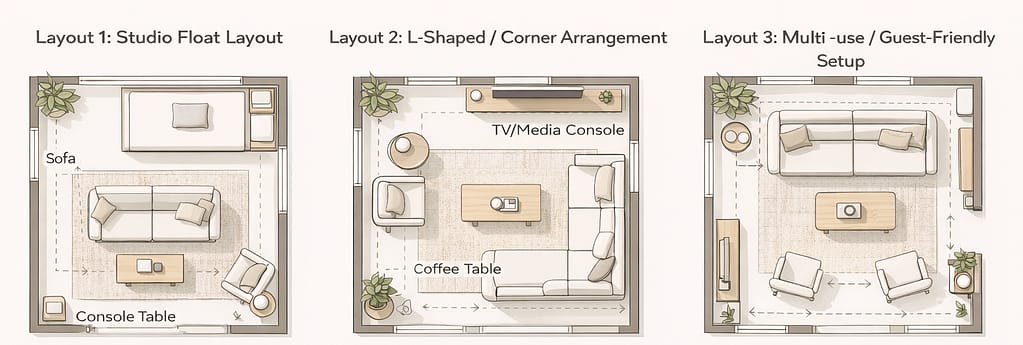
Awkward room shape? An L-shaped layout might be your answer.
Position your sofa along the longest wall, then add an accent chair or loveseat perpendicular to create an L. This naturally forms a conversation area and makes the room feel intentional rather than random.
Bonus: This layout works great for rooms with off-center windows or doorways that make symmetrical arrangements impossible.
5.3. Multi-Purpose / Guest-Friendly Layouts
Need your living room to host game nights, work-from-home sessions, and overnight guests? Here’s the setup:
- Sleeper sofa or futon against the main wall
- Lightweight accent chairs that can be moved easily
- Ottoman coffee table with storage (doubles as extra seating)
- Wall-mounted or fold-down desk for workspace
Everything serves at least two purposes, and nothing’s too heavy to rearrange when you need to.
6. Storage Solutions for Small Living Rooms
Let’s be honest, small living rooms and clutter are mortal enemies. Storage isn’t optional; it’s survival.
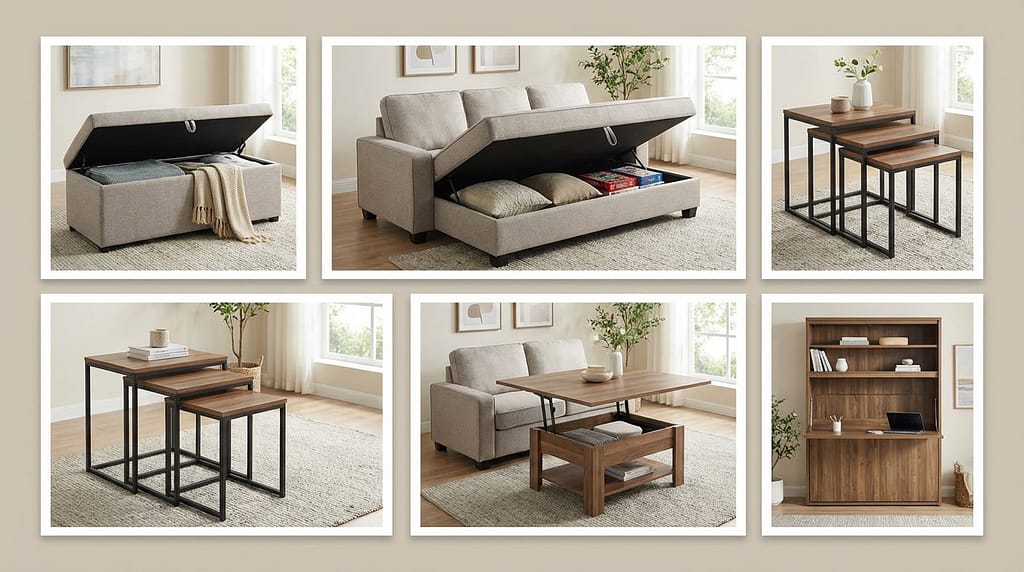
6.1. Sofas with Hidden Storage
Storage sofas are the unsung heroes of small-space living.
Best storage sofa features:
- Under-chaise storage: Perfect for extra blankets, pillows, or seasonal items
- Lift-top cushions: Quick access to everyday items
- Built-in drawers: Keep remotes, chargers, and magazines corralled
The IKEA FRIHETEN we mentioned earlier has a massive storage compartment under the chaise. Meanwhile, brands like Albany Park and Article offer sleeker storage options with better aesthetics.
6.2. Ottoman & Coffee Table Combo Ideas
Ditch the traditional coffee table and go for a storage ottoman instead.
You get:
- Hidden storage inside
- Extra seating when needed
- A footrest for Netflix marathons
- A tray on top turns it into a table
Pro move: Get multiple small ottomans instead of one large coffee table. They’re easier to rearrange and can be tucked away when you need floor space.
6.3. Multi-Functional Furniture Tips
Every piece of furniture in a small living room should earn its keep.
Ideas that actually work:
- Sofa with USB charging ports in the arms
- Nesting side tables that tuck away when not needed
- Floor lamps with shelving built into the pole
- TV stands with closed storage (no more visible clutter)
The goal? Everything has a home, and nothing is one-dimensional.
7. Fabric & Material Guide
The fabric you choose impacts everything from how your room feels to how much time you spend cleaning.
7.1. Best Fabrics for Small Spaces
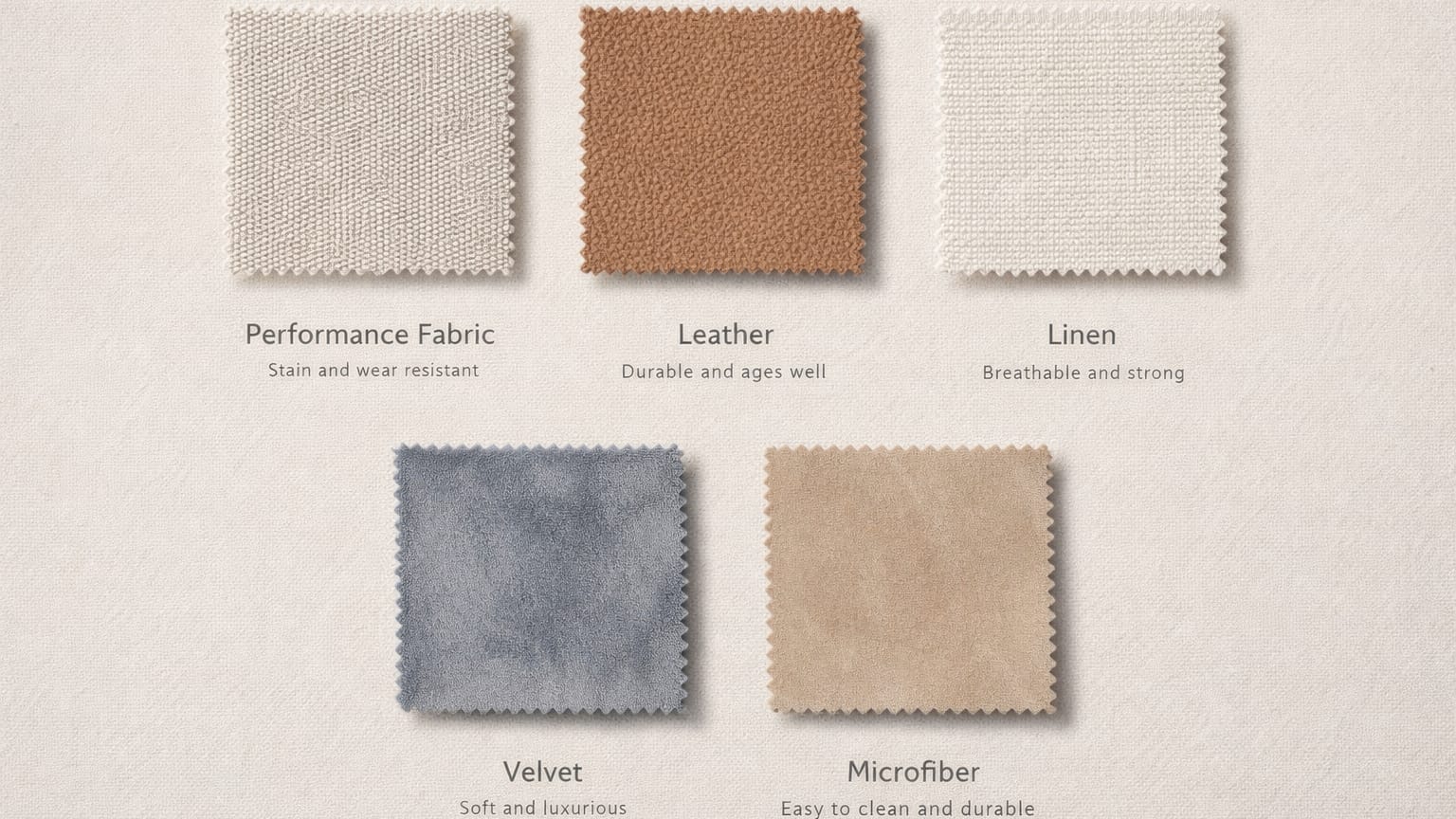
Performance fabrics are your MVPs. They resist stains, wear, and fading while looking like upscale textiles.
Top choices:
- Crypton: Nearly indestructible, resists stains and moisture
- Sunbrella: Originally for outdoor use, insanely durable
- Microfiber: Budget-friendly and surprisingly resilient
- Treated linen: Looks elegant, stays cleaner than you’d think
Light colors work best in small spaces, but treated fabrics mean you don’t have to sacrifice style for practicality.
7.2. Leather vs Fabric vs Velvet
Let’s break down the big three.
Leather:
- Pros: Ages beautifully, easy to clean, looks sophisticated
- Cons: Expensive, can feel cold or sticky, scratches from pets
- Best for: Child-free, pet-free homes with modern aesthetics
Fabric (cotton/linen blends):
- Pros: Comfortable, breathable, lots of color options
- Cons: Stains more easily, shows wear sooner
- Best for: Anyone prioritizing comfort over longevity
Velvet:
- Pros: Luxe look, surprisingly durable with quality construction
- Cons: Shows wear patterns, attracts pet hair
- Best for: Low-traffic rooms or design-forward spaces
7.3. Texture Tricks to Make Room Appear Larger
Here’s a design secret: texture adds depth without taking up space.
Mix materials thoughtfully:
- Smooth velvet sofa + chunky knit throw
- Linen upholstery + leather accent chair
- Sleek leather + woven jute rug
Avoid: Going too matchy-matchy. A room where everything is the same texture feels flat and actually smaller.
Light, textured fabrics reflect more light than smooth, dark ones, making your space feel airier.
8. Budget-Friendly Options & Where to Buy (US-Focused)
Let’s talk real-world budgets. Not everyone has $3,000 to drop on a sofa, and that’s totally okay.
8.1. Under $500
Where to shop:
- Walmart: Mainstays and Better Homes & Gardens lines
- Amazon: Zinus, Novogratz, and DHP brands
- Target: Room Essentials and Threshold collections
- IKEA: KLIPPAN, EKTORP (if you can snag it on sale)
What to expect:
- Mostly particle board frames (not hardwood)
- 3-5 year lifespan with normal use
- Limited color/fabric options
- Assembly required
Best picks:
- Zinus Jackie Sofa: ~$400, surprisingly comfortable
- Novogratz Brittany Futon: ~$350, converts for guests
- Mainstays Apartment Sofa: Under $300, basic but functional
8.2. $500–$1000
This is the sweet spot for quality-to-price ratio.
Where to shop:
- IKEA: SÖDERHAMN, KIVIK, FRIHETEN
- Wayfair: Mercury Row, Andover Mills brands
- Article: Some entry-level pieces on sale
- AllModern: Modern styles with decent construction
- West Elm (sales section): Occasionally find steals
What to expect:
- Mix of hardwood and engineered wood frames
- 7-10 year lifespan
- Better fabric options
- Some modular/customization available
Best picks:
- IKEA SÖDERHAMN: $800-$1,200, modular and stylish
- Burrow Nomad Loveseat (on sale): Sometimes dips to $900
- Wayfair Mercury Row sofas: $600-$900, good reviews
8.3. $1000+
If you can swing it, investing $1,000+ gets you something that’ll last 10-15+ years.
Where to shop:
- Article: Mid-century modern excellence ($1,200-$2,000)
- West Elm: Contemporary styles with solid construction
- Crate & Barrel: Classic designs, reliable quality
- Joybird: Customizable, made in the USA
- Room & Board: Premium quality, especially for compact options
- Burrow: Modular, easy assembly, great warranty
What to expect:
- Kiln-dried hardwood frames
- Eight-way hand-tied springs (in many cases)
- Premium fabrics (performance options available)
- Longer warranties (often 5-10 years)
Best picks:
- Article Sven: ~$1,500, gorgeous leather or fabric options
- Burrow Nomad: $1,200-$2,000, modular and pet-friendly
- West Elm Andes: $1,400-$2,000, mid-century classic
Pro shopping tips:
- Sign up for email lists, most stores offer 10-15% off your first order
- Shop holiday sales (Memorial Day, Labor Day, Black Friday)
- Check floor models and “as-is” sections for steep discounts
- Read return policies carefully (especially for online purchases)
9. Pros & Cons of Buying Brand vs Local / IKEA Alternatives
The eternal question: mainstream brand, IKEA, or local craftsperson?
Big Brands (West Elm, Crate & Barrel, Pottery Barn):
Pros:
- Consistent quality and sizing
- Easy returns/exchanges
- Showrooms to test before buying
- Established customer service
Cons:
- Higher markup
- Less unique (your neighbors probably have the same sofa)
- Limited customization
- Longer delivery times lately
IKEA:
Pros:
- Unbeatable price-to-quality ratio
- Modular systems
- Replacement parts readily available
- Washable slipcovers
- Immediate availability (usually)
Cons:
- Assembly required
- Shorter lifespan than premium brands
- Can feel “cookie-cutter”
- Quality varies by line
Local/Custom Makers:
Pros:
- Completely customizable
- Support local economy
- Unique pieces
- Often better construction than mass-market
- Can work with your exact measurements
Cons:
- Higher cost (usually)
- Longer wait times (8-16 weeks common)
- Can’t test before committing
- Limited return options
- Harder to find reviews
My honest take? For most people, IKEA or a mid-tier brand hits the sweet spot. Save custom/local for when you have specific needs that mass-market can’t meet (weird dimensions, specific fabric requirements, etc.).
10. FAQ Section
Can a small sofa fit in a 10×12 ft living room?
Absolutely! A 10×12 foot room (120 square feet) can comfortably accommodate a loveseat (60-72 inches) or even a compact three-seat sofa (up to 78 inches). The key is leaving 18-24 inches of walkway space around the sofa. Measure your room, subtract 3-4 feet from the longest wall (for walkways), and that’s your maximum sofa width.
How much clearance should I leave around a small sofa?
Aim for 18-24 inches of clearance on all walkway sides of your sofa. Between your sofa and coffee table, leave 14-18 inches, enough to walk comfortably but close enough to reach for your coffee. If your sofa backs up to a wall, you can get away with 2-3 inches of clearance there.
Are modular sofas better than sectionals for apartments?
Modular sofas offer more flexibility since you can reconfigure them, move them more easily (they break down into pieces), and adapt them as your needs change. Traditional sectionals are typically one solid piece or two connected pieces, making them harder to move and reconfigure. For apartments where you might move or rearrange frequently, modular wins. If you’re settled and know exactly what you want, a traditional sectional can be more affordable.
What’s the best sofa color for a small living room?
Light, neutral colors (soft grays, beiges, warm whites, light blues) make small rooms feel larger by reflecting light. That said, you can absolutely use darker colors if your room gets great natural light or you’re going for a cozy vibe. Just balance dark furniture with light walls and accessories to prevent the cave effect.
Should I buy a sleeper sofa for my small living room?
If you regularly host overnight guests and don’t have a spare bedroom, absolutely. Modern sleeper sofas are way more comfortable than old-school options and don’t sacrifice daytime comfort. Look for ones with memory foam mattresses and smooth mechanisms. Just make sure you have the floor space for the bed to extend fully.
How do I make a small living room look bigger with furniture?
Use furniture with exposed legs (raises pieces off the floor, creating visual space), choose light colors that reflect light, avoid oversized pieces, and consider transparent furniture like acrylic coffee tables. Also, float your sofa instead of pushing it against the wall, this counterintuitively makes the room feel larger by creating defined zones.
Is it worth investing in an expensive sofa for a small apartment?
If you’re planning to stay put for 5+ years and use your sofa daily, yes. A quality sofa ($1,000-$2,000) will outlast two or three cheap ones and actually save you money long-term. Plus, you’ll enjoy it more every single day. If you’re in a temporary situation or move frequently, stick with the $500-$800 range.
Can I fit a sectional in a studio apartment?
You can, but choose carefully. Look for compact L-shaped sectionals (under 85 inches total) with a chaise rather than a full second section. Place it strategically to divide your sleeping area from your living area. Skip the sectional if your studio is under 400 square feet, you’ll need the flexibility of separate pieces.
11. Conclusion & Internal Linking
Finding the best sofa for a small living room doesn’t have to be overwhelming. Start with your measurements, think about how you actually use your space, and be realistic about your budget. Whether you go with the budget-friendly IKEA SÖDERHAMN, the design-forward Vitra Slow Sofa, or something in between, the right sofa can completely transform your small space from cramped to cozy.
Remember these key takeaways:
- Measure your space carefully (including doorways!)
- Choose light colors and raised legs for visual space
- Prioritize multi-functional pieces when possible
- Don’t sacrifice quality in the $700-$1,200 range if you can help it
- Consider modular options for maximum flexibility
Your perfect small-space sofa is out there. Now go find it, and enjoy every inch of your cozy, well-designed living room.
Did this guide help you? Share it with a friend who’s hunting for the perfect small-space sofa! And don’t forget to measure twice before you buy. 😊





4 thoughts on “Best Sofa for Small Living Room: The Ultimate 2026 Guide”